Focal length is one of the first terms tossed at you if you are new to photography. If you’re buying a camera lens, you must decide on the one you want. If you are looking at a zoom lens, there are many focal lengths to choose from. So, how do you decide which is best?
By the end of our article, you’ll understand what focal length is and which will suit your photography best. We review the technical definition for photographers who want to understand the inner workings of lenses and cameras.
But the practical implications of focal length are what matters to most photographers. So, we’ll explore how different focal ones affect the photos we take.
[courses="Beginner"]
What Is Focal Length in Photography?
Focal length is a fundamental photography concept in optics and camera lenses. It is the distance from the optical center of a lens (point of sharpest focus) to the camera sensor or film. It is measured when the lens is focused at infinity and is usually expressed in millimeters (mm).
How Is Focal Length Measured?
Camera lens manufacturers measure the distance between the point of sharpest focus and the camera’s sensor (or film). That is the focal length of the lens. They then label each lens with its measurement in millimeters (mm).
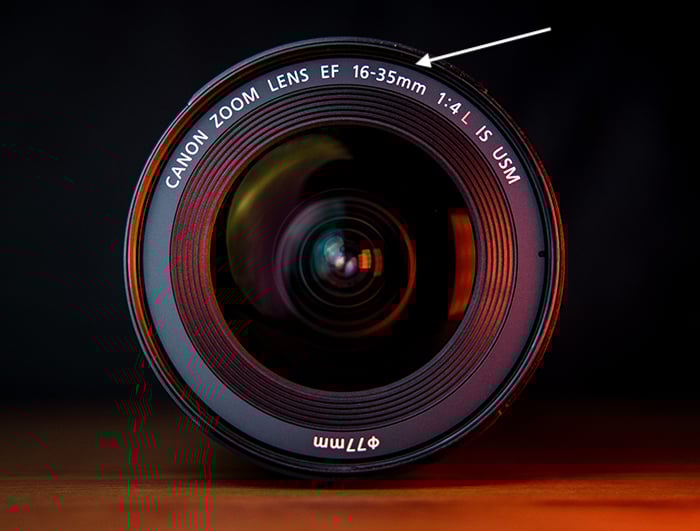
A Canon zoom lens with a 16-35mm focal length.
A lens has many different pieces of glass elements that interact to direct light into a camera. And there is a point where light crosses (converges) on its way to the sensor. This is the point of sharpest focus.
Look at the diagram below showing the side view of a lens. Light comes into the front of the lens. It passes through many layers of glass with different shapes and curves. And these elements focus light to make a clearer image.
In our example, the point of sharpest focus (point of convergence) is 28mm from the camera sensor. So, this lens has a focal distance of 28mm.
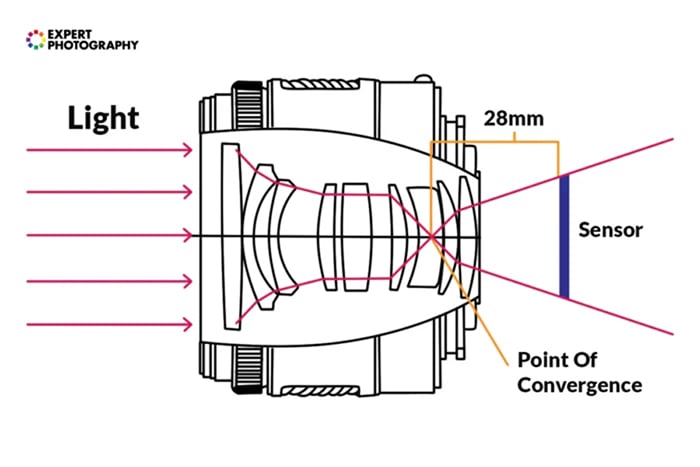
Side view of a lens with a focal length of 28mm.
How Is Focal Length Standardized?
Lenses are tested by focusing at infinity to standardize focal length measurements. This is because the point of convergence changes as you focus closer or further away.
When you focus on a point far in the distance, the light rays hit the lens almost parallel, as shown in the diagram above. Light enters the lens at an angle when focusing on a closer subject.
Your lens handles this, but it affects how much of your scene is in focus. For more on this, read our article on depth of field in photography.
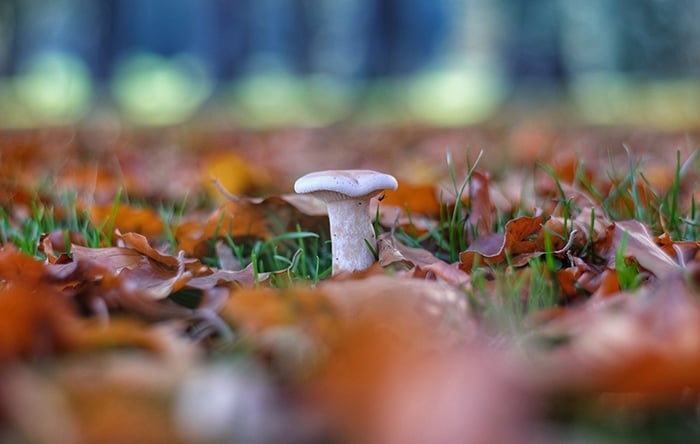
Close focus changes how light enters the camera and how much is in focus (75mm lens).
Focal Length vs Lens Length
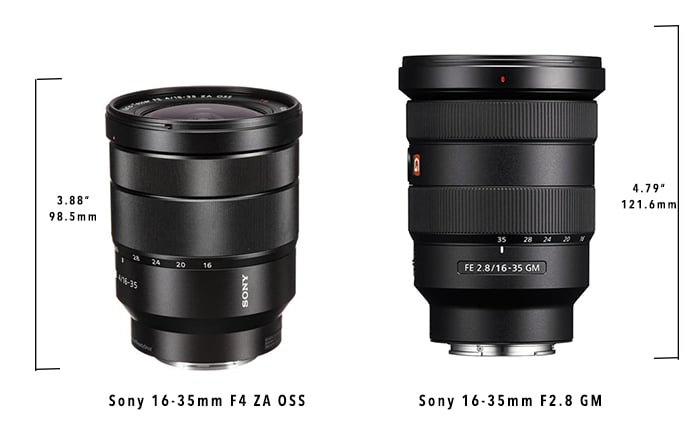
Focal length has to do with the inner workings of a lens. It is not the physical length of a lens from the glass on the front element to the lens mount that attaches to your camera. Lenses can have the same focal length and be very different in physical size.
These two lenses below cover the same focal length (16-35mm). But they have different internal constructions. For more information about how lenses are constructed, see our beginner’s guide to camera lenses.
How Does Focal Length Affect Photos?
Different focal lengths affect the way our photos look. For instance, a longer focal length means a lens has a narrower angle of view, greater magnification, and a compressed perspective. So, we’ll look at these three ways focal affects photography in practice.
1. Angle of View
Focal length affects your angle of view, which is how much of the world your camera lens can take in. A lens with a shorter focal length, like 24mm, can see more of the scene than a lens with a long focal length, like 300mm. Lenses with smaller numbers capture a more expansive view.
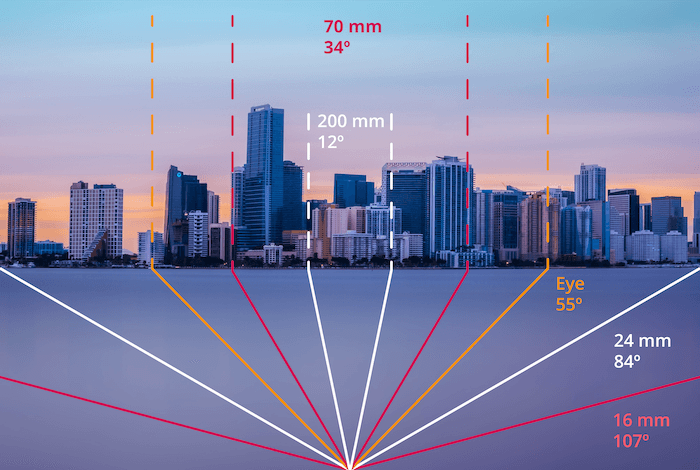
Focal length examples and how much your camera can capture.
If you look straight in front of you, the area you can see is about 55 degrees. That is your angle of view. You have a greater field of view with your peripheral vision. But off-center areas are not in focus. To see more of the world, you must turn your head.
A 43mm lens captures a similar amount of the scene, about 53 degrees. So, 50mm lenses are popular because they capture the world very close to how we see it. Photographers sometimes call a 50mm lens a “nifty-fifty.”
This table shows the angle of view for lenses with popular focal lengths.
| Focal Length | Angle of View (Degrees) |
|---|---|
| Fisheye | {{column-name-2}}: 180° |
| 12mm | {{column-name-2}}: 122° |
| 14mm | {{column-name-2}}: 114° |
| 16mm | {{column-name-2}}: 107° |
| 20mm | {{column-name-2}}: 94° |
| 24mm | {{column-name-2}}: 84° |
| 28mm | {{column-name-2}}: 75° |
| 35mm | {{column-name-2}}: 63° |
| 50mm | {{column-name-2}}: 47° |
| 70mm | {{column-name-2}}: 34° |
| 80mm | {{column-name-2}}: 30° |
| 85mm | {{column-name-2}}: 28° |
| 90mm | {{column-name-2}}: 27° |
| 100mm | {{column-name-2}}: 24° |
| 135mm | {{column-name-2}}: 18° |
| 200mm | {{column-name-2}}: 12° |
| 300mm | {{column-name-2}}: 8° |
| 400mm | {{column-name-2}}: 6° |
| 500mm | {{column-name-2}}: 5° |
| 600mm | {{column-name-2}}: 4° |
2. Magnification
Focal length also affects how close objects seem to be. A lens with a long focal length magnifies objects, making the subject appear closer. If you photograph far-away subjects, use a 400mm or 800mm lens.
Your angle of view is smaller, but magnification increases. The focal length of the lens determines how zoomed-in your photos look. The higher the number, the more zoomed your lens can be. Different focal lengths change how visually close the subject is.
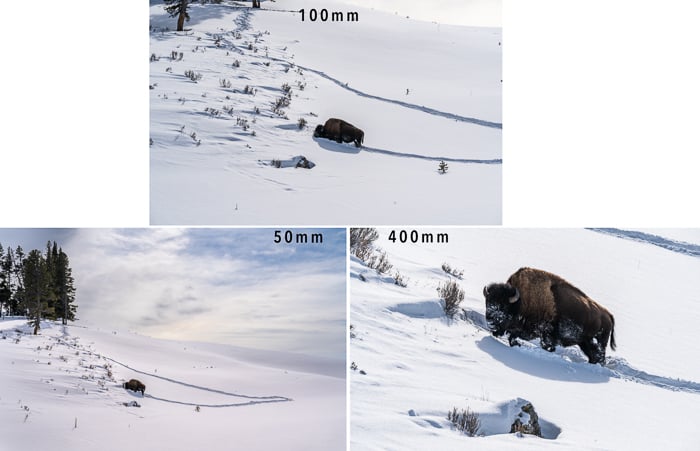
Focal length comparison of shots taken from the same position.
3. Perspective Compression
Focal length also affects how objects look in relation to each other. Lenses with longer focal lengths compress the scene and make elements of the scene look closer together.
Look at the four photos below of the same subject at different focal lengths. The three soup cans remained in the same position. They were spaced 10 inches (about 25 cm) apart. The camera was moved back to keep the cans framed similarly.
The cans seem spaced further apart at 24mm than 135mm. At 300mm, the cans seem almost next to each other.
Also, notice the relative size of the cans. At 24mm, the front can is much more prominent than the others. At 300mm, the can in the back looks just as large, if not larger, than the cans in front. Remember, the cans were not moved.
This visual illusion is called “perspective compression.” Lenses with a longer focal length appear to compress objects. Lenses with shorter focal lengths add visual space between objects. You can choose which one is right for shooting a scene.
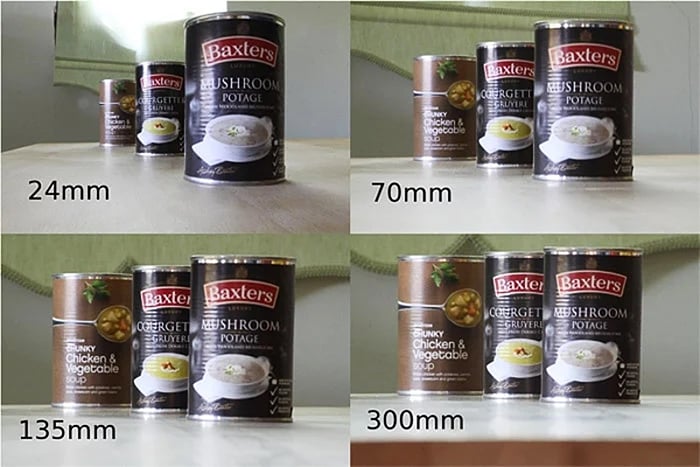
Perspective comparison
How Does a Camera’s Sensor Affect Focal Length?
A camera does not directly affect focal length. But the size of your camera’s sensor can impact how zoomed-in your photos appear.
A lens attached to an APS-C (crop) sensor camera has a scene that looks more zoomed-in than a lens with the same focal length attached to a full-frame camera. This is when a camera’s crop factor comes into play.
Lenses are tested on cameras with a full-frame sensor when determining their focal length. Full-frame cameras are equivalent to the once-popular 35mm film cameras. They have become the standard for measurement.
But some cameras have smaller sensors. For instance, many cameras have an APS-C sensor. It is about 1.5x smaller than a full-frame sensor. That is the crop factor of the camera.
When mounted on a camera with a smaller sensor, a 28mm lens looks the same as a 42mm lens. The “perceived” focal length is sometimes called the “effective” or “equivalent” focal length.
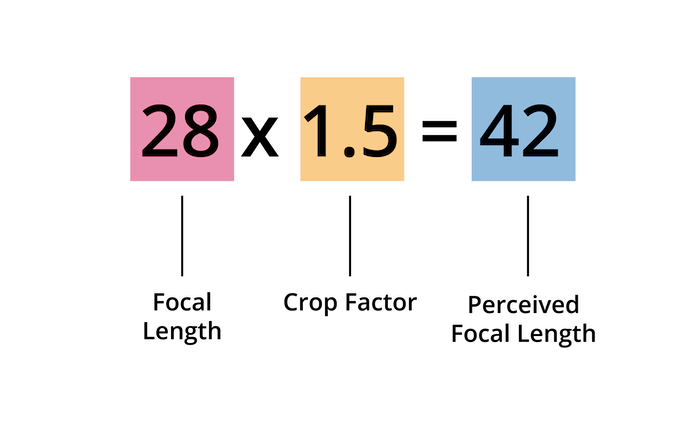
All lenses are labeled with a focal length as though mounted on a full-frame camera. Even if the lens was designed for a crop-sensor camera, that’s the case.
It’s not a problem if you have a crop sensor. You get used to how the lens captures a scene on your camera. But if someone suggests you use or buy a 50mm lens, know it will be cropped on your camera. It will act like a 75mm lens.
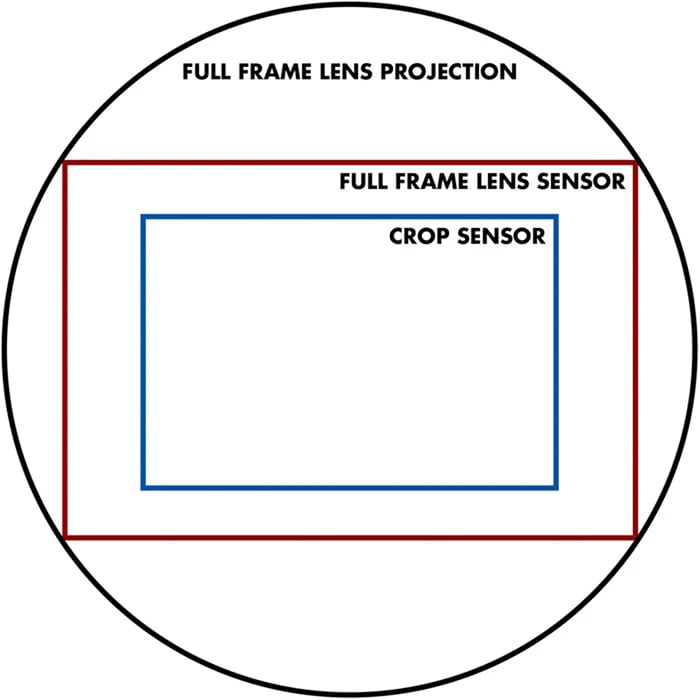
To know more about crop sensors, read our article about camera sensor sizes. This table shows popular lenses’ equivalent focal lengths and angles of view.
| Focal Length | Equivalent Focal Length 1.5x crop factor | Angle of View |
|---|---|---|
| 12mm | {{column-name-2}}: 18mm | {{column-name-3}}: 122° |
| 16mm | {{column-name-2}}: 24mm | {{column-name-3}}: 107° |
| 24mm | {{column-name-2}}: 36mm | {{column-name-3}}: 84° |
| 35mm | {{column-name-2}}: 53mm | {{column-name-3}}: 63° |
| 50mm | {{column-name-2}}: 75mm | {{column-name-3}}: 47° |
| 70mm | {{column-name-2}}: 105mm | {{column-name-3}}: 34° |
| 90mm | {{column-name-2}}: 135mm | {{column-name-3}}: 27° |
| 100mm | {{column-name-2}}: 150mm | {{column-name-3}}: 24° |
| 200mm | {{column-name-2}}: 300mm | {{column-name-3}}: 12° |
| 400mm | {{column-name-2}}: 600mm | {{column-name-3}}: 6° |
Zoom vs Prime Lenses
Camera lenses are divided into two categories based on whether they can change focal length. A lens with one fixed focal length is a prime lens. If a lens can change focal lengths, it is a zoom lens. In general, prime lenses are sharper and often have a wider aperture.
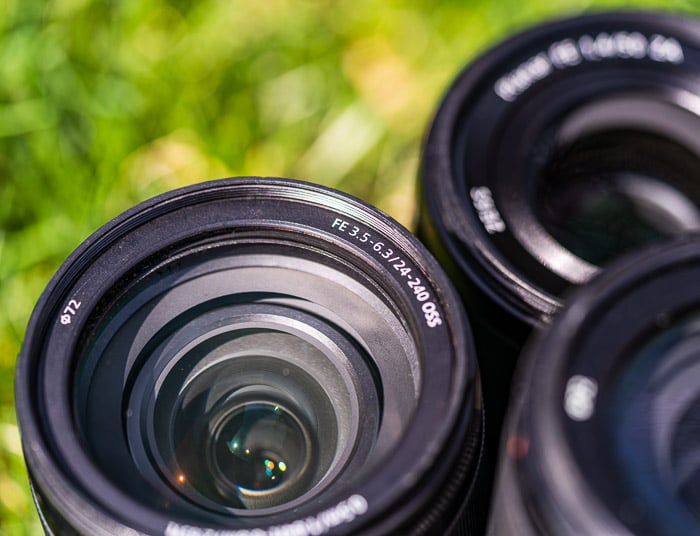
Zoom lenses let you change the angle of view and magnification within a range of focal lengths. For instance, a 16-35mm zoom covers everything between 16mm and 35mm. You can choose 20mm, 24mm, or 30mm by twisting the lens barrel. That gives you a lot of versatility.
Most variable focal length lenses get longer physically as you zoom. And lens manufacturers label zoom lenses by listing the shortest and longest lengths.
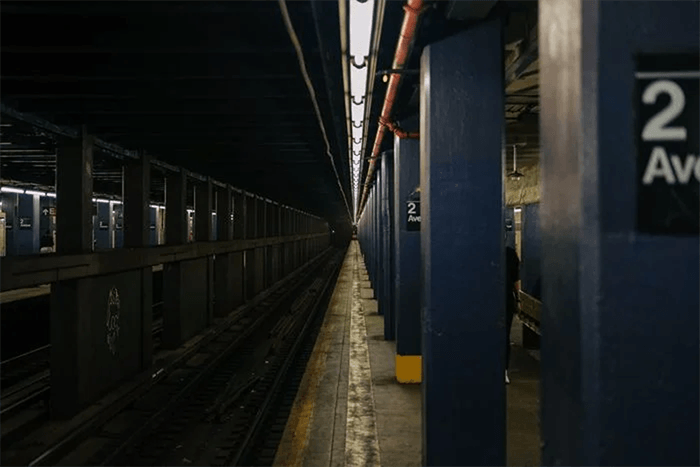
Shot with a 35mm prime lens.
How Are Lenses Grouped By Focal Length?
In photography, we group lenses by their focal length in many ways. There are ultra-wide, wide-angle, standard, telephoto, and super-telephoto lenses. Let’s go over the main types of lenses in photography and how they’re grouped.
1. Ultra-Wide-Angle and Fisheye Lenses (Less Than 16mm)
Lenses less than 16mm are sometimes referred to as “ultra-wide-angle.” A fisheye lens is an example of an ultra-wide-angle lens. These are often considered specialty lenses. They create such a wide angle of view that they feel unnatural and seem to distort reality.
Ultra-wide lenses are often used in event and architectural photography. They get a lot into a photo when shooting in a confined space.
When used in journalism, ultra-wide angles can provide a dramatic, exciting angle—especially if you are close to the subject. A 16-35mm or 14-24mm zoom, for example, is a crucial tool in the bag of a press photographer.
A fisheye is an ultra-wide-angle lens that emphasizes wide-angle distortions. Fisheye lenses are usually between 4mm and 16mm and capture up to a 180-degree field of view.
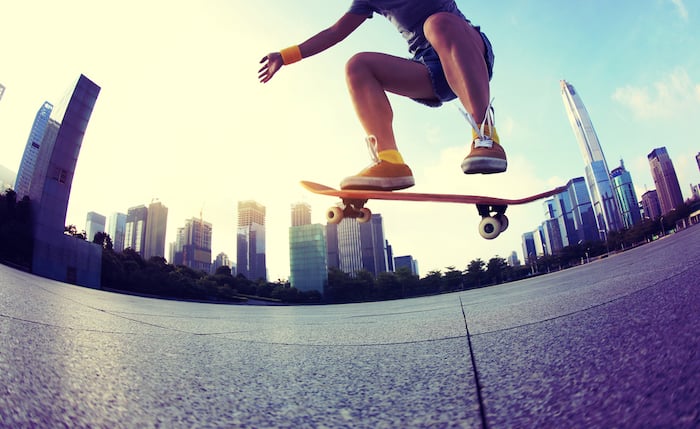
Taken with a 15mm fisheye lens. (DepositPhotos)
2. Wide Angle Lenses (Less Than 35mm)
Lenses are wide-angle if they have a focal length of 35mm or less. Wide-angle lenses capture a broad view of the world. The view is more comprehensive than you can see at a glance.
Street photographers and photojournalists use lenses with shorter focal lengths. They can get close to their subjects, work indoors, and put themselves in tight spaces. These lenses capture the subject and the context.
Landscape photographers also love short focal lengths. They can capture large natural scenes like mountains and tall waterfalls. This wide-angle perspective is advantageous. You can make a flower in the foreground look more prominent than the mountain in the background.
The widest lenses commonly used in movie production also fall into this range. Their field of view is ideal for showing plenty of the environment. And thanks to the wide aspect ratio, subjects can be far enough away not to appear distorted.
But photographers rarely use lenses with short focal lengths for portraits. They enhance the perspective so much that facial features can look unnatural.
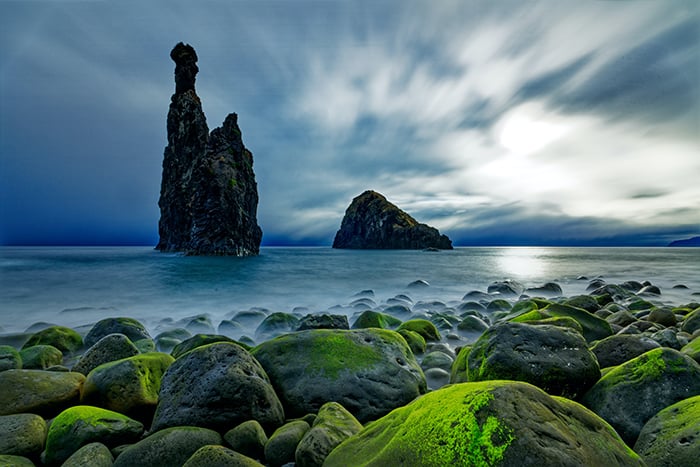
Take with a 20mm wide-angle lens.
3. Standard Lenses (35-70mm)
A standard lens is between 35mm and 70mm. These are the most common lenses, both in prime and zoom format. The focal lengths of the kit lens you get with your first camera probably cover some, if not all, of this range.
Portrait photographers often use standard 50mm and 70mm portrait lenses, which are very popular. Lenses in this range best reproduce what our eyes see. They have minimal distortion. So they are suitable for documentary and street photography.
You can use standard lenses for virtually anything, from nature to action. If you want a good walking-around lens, buy one covering focal lengths between 35 and 70mm. A popular standard zoom lens is 24-70mm.
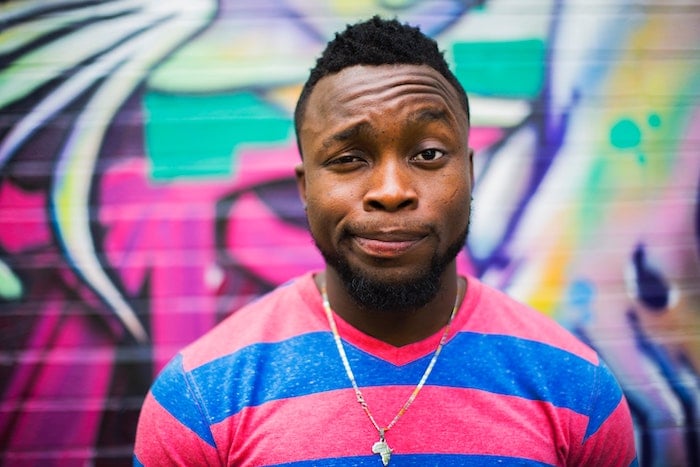
Shot with a standard 50mm lens.
4. Telephoto (70mm+) and Super-Telephoto (200mm+)
Lenses are described as telephoto if they have a focal length of more than 70mm. Lenses longer than 200mm are sometimes referred to as “super-telephoto.”
A lens is sometimes called a “short telephoto” if the focal length is between 70mm and 135mm. Currently, the longest telephoto lenses in production for consumers are 1200mm.
Photographers use telephoto lenses any time they are photographing something from a distance. Wildlife and sports photographers often use telephotos to bring their subjects closer.
Landscape photographers use long focal-length lenses to capture intimate landscapes. Remember, telephoto lenses compress the scene and make objects look closer together. That is not always what landscape photographers want.
Portrait photographers may also use telephoto lenses, like 85mms if they take close-up shots. The lens compresses the subject, and they look leaner. It is often a flattering look.
Many popular macro lenses also fall into the telephoto category. Photographers use macro lenses to photograph detail in extreme close-ups. A telephoto macro also gives you a little working space.
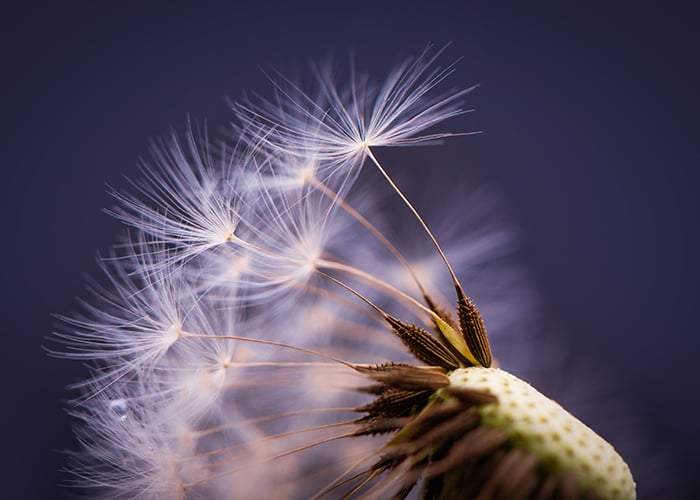
Shot with a 105mm macro lens.
What Focal Length Is Best in Photography?
The best focal length for your photography depends on the type of photography you like to shoot. Let’s review the best ones for some of the more common genres of photography.
1. Portrait Photography
If you like photographing people, the best focal lengths are between 50 and 135mm. You can get standard prime portrait lenses like 50mm with less distortion. Or you can buy a zoom lens covering the lower end of the range, like a 24-70mm or a 24-105mm.
A short telephoto would also be a good buy for you. Many portrait photographers use a 70-200mm lens.
2. Landscape Photography
Landscape photographers vary in their preferred lenses. You may like a wide-angle 16-35mm lens for grand landscapes. Or you may pick a telephoto lens like 100-400mm to capture details in the scene.
If you like to photograph landscapes, you may need to try a few different lenses to see what fits your favorite landscape scenes.
3. Street, Documentary, and Travel Photography
If you like to travel and take photos on the street, a standard lens is your friend. A 24-70mm is the go-to lens for travel and street photography.
But many street and travel photographers use wide-angle prime or zoom lenses in the 16-35mm range. This lets them get in close and show a lot of the scene. If you are going into the unknown, you may want to look at a lens that covers a variety of situations, like a 24-105mm lens.
4. Architecture Photography
Architectural photographers often go with wide-angle lenses. They may shoot tall buildings on narrow streets. Or they may be inside an establishment trying to capture a tight corner or the majesty of a cathedral.
A wide-angle lens works for it all. Architectural photographers may even pull out an ultra-wide-angle (12-24mm) or a fisheye lens when space is tight.
5. Sports and Wildlife Photography
Sports photographers and wildlife photographers share some common challenges. You may not be able to get close to your subjects, so a telephoto is a must. You need a 70-200mm or a 100-400mm lens.
You may even need a super-telephoto lens if you are trying to photograph birds or players on a large field. And 800mm prime lenses are made for these situations. We review both the best sports lenses and wildlife photography lenses to buy.
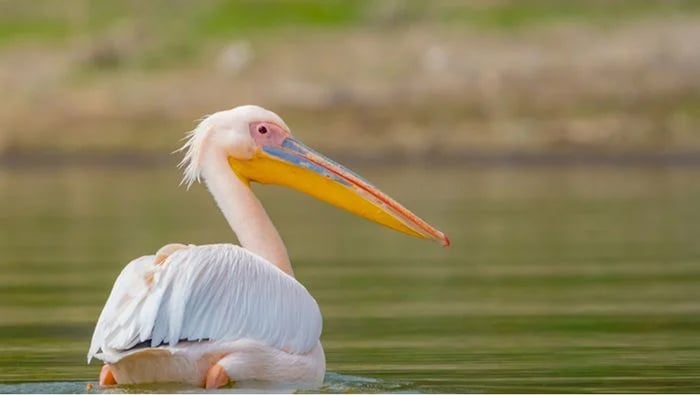
Shot with a 600mm super-telephoto lens.
Conclusion: Focal Length in Photography
The technical definition of focal length is the distance between the point of convergence in the lens and the camera’s sensor. But it is the practical differences between them that matter to most photographers.
A lens’s focal length affects how much of the scene you can capture. It also affects how visually close you can get to your subject and the relationship between objects in the scene. The best one for your photography depends on what you shoot and how you see the world.
A wide-angle lens has a short focal length. It sees an area more expansive than the human eye. Telephoto lenses have long focal lengths. They have a much smaller angle of view but bring distant subjects closer. And, of course, there is much more in between for you to choose from!
Try our Photography for Beginners course for a fun and easy way to learn more!
[courses="Beginner"]