Tag Archives: Visual Weight

Where to Focus When Taking a Photo

Most beginner photographers don’t know where to focus when taking a photo, and worse still, they don’t seem to know why it’s a problem either.

You may think that because you’re shooting a landscape photo, and your horizon is miles away, it’s best to focus to infinity.

Wrong.

Let me show you the error of your ways.

Hyperfocal Distance

You don’t need to fully understand how the following works, but you do need to understand the concept.

The depth of field is largely dependant on your aperture, as well as your distance from the subject. There’s also another factor called your hyperfocal distance. Without boring you, or going into too much detail (this subject is worthy of a post itself), your hyperfocal distance is the distance at which you focus, where everything after it (stretching to infinity distance) remains acceptably sharp.

Half of the distance between the hyperfocal length and the lens will also remain acceptably sharp too.

Working out your hyperfocal distance involves complicated maths which involves your distance from a subject, your f/stop, your focal length, and the size of your sensor. Don’t bother trying to work it out yourself, just download an app for your phone, or follow the general rules I’m going to teach you in this post.

I’ll go into this in further detail in another post, but for now, this is what you need to know:

If you focus at infinity, you lose lots of your depth of field, because there will be barely any focus infront of infinity, and nothing behind the focus (because you’re already focused to infinity).

Don’t focus to infinity, unless you’re trying to focus on a single subject, located at infinity. 

Landscapes

So now with your new found knowledge on the hyperfocal distance, you will either be very confused as to where to focus in a landscape, or darn sure that you shouldn’t focus to infinity. But where do you focus?

Lets say you’re shooting a landscape, and your aperture is f/11, and your focal length is 24mm. You’re also shooting on a Canon crop sensor (slightly smaller than Nikon). Your hyperfocal distance is roughly 9 feet. If you focus here, your photo will be acceptable sharp from anywhere 4.5 feet in front of your camera, all the way to infinity.

But that’s maybe a little bit too specific. And it changes every time you adjust your aperture, and focal length, so that’s no good.

Here’s some real science right here… focus about a third of the way into the frame.

As a rule, you can’t go too far wrong with this. If you’re shooting a landscape, then chances are your aperture is quite narrow, so you have a decent DoF to play with.

Here’s the difference between a photo where I focus about a third of the way to infinity…

Devils Dyke Sunset 2012 05 13 at 21 27 55 74 Where to Focus When Taking a Photo

… and one where I focused to infinity.

Devils Dyke Sunset 2012 05 13 at 21 28 04 75 Where to Focus When Taking a Photo

Can you see the difference?

You may notice that the focus on your camera only goes to about 15 feet until it reaches infinity. If you’re in doubt, you can’t go too far wrong by focusing to infinity, and then pulling the focus back a little bit (so that you’re no longer at infinity).

Portraits & People

Lets start by talking about a single subject here.

If you remember what I wrote about visual weight, the strongest visual weight comes from a person’s eyes. We’re automatically drawn to a person’s eyes, so clearly, that is where we need to focus.

I’d like to think that’s pretty obvious. Especially when you’re using a wide aperture with a shallow depth of field.

Have a look at my photo below. It was shot at f/1.4, which produces an exceptionally shallow DoF, but because I focused on her eyes, you can’t really tell.

 Where to Focus When Taking a Photo

How about a group of people though? Where do you focus then?

Well, we’re back to hyperfocal distance here. The DoF always extends further into the distance, than it does in the foreground. What does this tell you about where you should focus?

Think about it, I’ll wait…

You want to focus on the eyes of the person closest to the camera. This is where you’ll be drawn to first, and if it’s not in perfect fous, then everything else is going to seem out of focus.

From here, the focus will gradually decrease naturally.

IMG 4148 Where to Focus When Taking a Photo

Focus and Recompose

This is something you’ve probably heard of before, in fact, you’ve probably even done it. You focus on a certain part of the frame, such as a person’s eyes, and then you recompose the photo how you want it. This ensures for good focus and composition.

To do this, you need to use your focal lock, which means shooting on either One-Shot mode, or AF-S. When you click the shutter button down half way, it will focus, and then hold the focus until you’ve recomposed and taken the photo.

I would also recommend using the center focus point, rather than all of them together, or any specific focus point. This is because it’s easy to select, and this is where you camera will meter from. 2 birds with one stone.

Be careful about using this technique when you’re using a wide aperture with a very shallow DoF, because even the slightest movement can throw the photo out of focus. Where to Focus When Taking a Photo1 Where to Focus When Taking a Photo

A Beginner’s Guide to Composition

Composition is a funny old thing, because it’s common knowledge that learning composition will help your photography, but it’s also something you should never really pay too much consideration too. I always feel that it’s best to teach people composition under the guidance that it’s training a person’s eyes to look at a potential photo in a different way. You should never just blindly follow the ‘rules’, but you can use your new knowledge to shape your photos into something which is much more pleasing to the eye.

Rule of Thirds

This is probably the first compositional rule that any photographer comes across, and that’s for a very good reason – it’s simple and it works. The basic premise is that you divide your camera’s frame up into thirds and plant key objects in these lines, and the composition will work better. This often works really well and if you’ve not learnt much about photography yet – it’s a great way of dramatically improving your photos and make them more interesting. The idea is that the viewer gets to see more than just the subject and is free to, and encouraged, to explore the photo themselves. There are more basic elements of composition to study, but this is great for trying out and getting to grips with compostion.

Here is the full tutorial on the Rule of Thirds. A Beginners Guide to Composition

Visual Weight

Visual weight is different to size or weight as we know it, and it’s largely down to different elements, such as human eyes and writing. When you can understand visual weight a lot more, you’ll start to understand how people look at photos, and how you can position certain elements in a frame to direct the viewers attention. It’s not so much a tool, or a rule, as it is an understanding.

Here is the full tutorial on Visual Weight. A Beginners Guide to Composition

Balance

Balance in a photo has a big affect on how we feel when we look at the photo, as an unbalanced photo can make us feel uneasy, where as a balanced photo, will make us feel more relaxed. It really doesn’t matter whether you choose to make the photo balanced or unbalanced, but you should understand why you’ve chosen one or the other, and have reasons to justify this choice. Again, it’s one of those situations where the more you know, the easier it will be to produce the desired effect.

Here is the full tutorial on Balance. A Beginners Guide to Composition

Eye-Lines

If you take photos of people, then you take photos with eye lines, so it’s important to understand the affect that they have over how we view photos. Seeing as you’re definitely following every tutorial I’ve provided in this guide, you will have a good understanding of visual weight already, so you should understand the power that having a face (and eyes) in a photo has on it. But there’s much more to it than that. Eye-lines have the ability to focus our attention on another part of the photo, as well as producing tension and other photographic elements. Although they’re not physical lines, they can be used as such to produce different elements, such as triangles and vertical lines.

Here is the full tutorial on Looking & Interest.

 A Beginners Guide to Composition

Triangles

Speaking of triangles, lets have a look at them next. Triangles are in almost everything we see, in one way or another, it’s just a case of distinguishing them and knowing what to do with them. They make great compositional tools as they’re easy to make, manipulate, and are remarkably common. Triangles are a great way of combining different compositional techniques such as lines and paths and using them to create a more interesting part of a photograph, but the best part about using a triangle is their ability to make a photo feel stable or unstable.

The majority of your photos will have three distinguishable points of interest, so it’s just a case of identifying these, and linking them together in a way that makes sense.

Click here for the full tutorial.

 A Beginners Guide to Composition

Single Point

Before we get ahead of ourselves, we should really look at what a single point does to a photo, because there’s actually much more to it than meets the eye. When you’re working with a single point of interest in a photo, it’s one of the most basic forms of composition available, so quite a common occurrence and it pays to know what to do with it. A single point can provide interest to an otherwise plain photo, and they’re usually fairly small and contrasting to the rest of the photo. A photo doesn’t need to have any points of interest to be successful though, just have a look at the most expensive photo in the world as an example.

Here’s the full article. A Beginners Guide to Composition

Horizons

When a frame is being divided by a single, dominant line, it’s more often than not, a horizon, as they’re fairly common in outdoor photography, particularly landscapes. If the photo is of nothing particularly interesting, then usually this line becomes the dominant part of the photo for the way in which it separates the frame. Exactly where you place the horizon in a frame can have a huge affect on the image; it’s all about which part of the photo is the most interesting, and how you want to make your viewer feel with the divide. A Beginners Guide to Composition

Frame Within a Frame

Frames are a great way of using a photographic element to lead the viewers eyes into the frame to focus them on a particular point, and the sense of repetition that they can provide, produce depth and a path for the eyes to explore. A photo of a scene with a foreground feature makes for much more interesting build up to the main part of a photo and can, in some cases, carry equal weight to the rest of the photo.

Click here to read the full tutorial. A Beginners Guide to Composition

Dynamic Tension

Dynamic tension is a way of using the energy and movement available in various features of the frame, to draw the eyes out of the picture in contrasting directions. We’ve already looked at a variety of different lines that you can use in a photo to make it more interesting, but dynamic tension takes these lines and adds varying degrees of contrast between them, making them much more interesting. The simplest and most obvious photo that I have that demonstrates dynamic tension is the one below – the lines move out from the center of the photo to edge of the photo.

This is where composition can start to get a little bit more advanced, but tends to lead to more interesting photography, as you take the knowledge that you’ve already learned, and use it to create photos with more depth.
 A Beginners Guide to Composition

Depth

Speaking of depth, here’s some useful tutorials to produce depth in your photos. It’s another page like this, with links to the relevant articles, but if you’ve got the time, and you want to learn more, then it’s really worth checking out.

When we take a photo with our cameras, we turn a 3D image into just 2D, and that can cause problems when you’re trying to display depth. It has its advantages and disadvantages, depending on what you’re trying to convey with your photo, but ultimately it holds you back when you’re trying to add depth to a photo.

Click here to check out the full article.train station A Beginners Guide to CompositionA Beginners Guide to Composition1 A Beginners Guide to Composition

10 Classic Tips For More Interesting Portraits

A lot of people think that they can’t take good portraits because they’ve not got the right lens, or the right lighting, but that’s simply not true at all. Learning how to take great photos takes time, but these 10 tips should make a big difference if you start to follow them all.

Experiment with Focal Lengths

You’ve probably heard the term ‘portrait lens’ before, and that’s because portraits typically look best at slightly longer focal lengths of around 70-115mm, but that doesn’t mean that they’re the only lenses that you should use. I like to shoot with a wide angle quite often, and they can make for some really interesting portrait photos, as you can include more in the frame than you would have been able to at a longer focal length.

In the photo below, I was able to provide context to the shot, along the dark shadows, and details to the large rocks, that would have been cropped out to a simple blue sky if I’d used a longer length.IMG 3718 2011 06 03 at 19 19 52 10 Classic Tips For More Interesting Portraits

Experiment with the Background

It always amazes me that someone would shoot with a white background, when with just a little bit more effort, they could have found a much more interesting location. The background is part of the photo too, and it can help to provide the viewer with more information about the photo. I like to take models out to interesting locations that I scout out beforehand, because the results are much more natural, and if I find somewhere outside, the lighting can produce a wider range of results.

Even when you have to have a fairly plain background like in the photo below, It’s easy enough to find a location just slightly more interesting, which will produce a much better photo. When you compare the paleness of the wall, to the texture of the wooden door, there’s no question about which is better. 10 Classic Tips For More Interesting Portraits

Break the ‘Rules’ of Composition

I like to go on about how important composition is to taking good photos, and that’s because it is, but equally important is knowing how to use this new knowledge properly, and knowing when to forget it. The ‘rules’ of photography are made to be broken, and often you can produce the best results when you forget about what you’re ‘supposed’ to be doing, and go ahead and shoot whatever feels right. I find this often comes about when I’m experimenting, or taking test shot, and more often than not, when I’m not even looking through the viewfinder.

The most common rule for taking photos of people is the rule of thirds, and it works tremendously well, but when it comes to portraits, forgetting about this rule can be much more dramatic. Have a look at the photo below as an example.Keira 9788 10 Classic Tips For More Interesting Portraits

Play with Eye Contact

If you’ve read my tutorial on visual weight, or eye-lines, then you’ll know all about the power that eyes have in a photo. They contain some of the strongest visual weight in any photo as we’re naturally used to looking at them, so you should use this knowledge to your advantage. When the eyes are looking straight down the lens, we look at them first, and then look at the rest of the photo in order of interest. When the eyes are looking away from the camera, then they can be much more powerful at times, as we become naturally interested in where the subject is looking.

Have a look at the comparison I’ve set up below, and see which one strikes you as being the most interesting. Portraits typically have the subject looking down the lens, but that doesn’t mean you have to.Keira 9501 10 Classic Tips For More Interesting Portraits

Try Candid Photography

I love candid photography so much that I actually wrote a whole post on the topic, because it’s not often that you capture people in their natural state in any other way. As soon as you point a camera at someone, especially if you shout ‘say cheese!’, people become self conscious, tense up and you lose any natural feeling to the photo. There is a way around this, which I cover in my final point, but overall, these photos tend to lose their spark.

When people aren’t aware that you’re looking at them, you can wait patiently for the right moment to capture an image and end up getting much better results. You can also provide much more interesting foreground and background details as where you’re shooting from will also be captured in the shot. 10 Classic Tips For More Interesting Portraits

Play with Light

An exposure is really just a capture of light for a certain amount of time, so to make an exposure more interesting, it makes sense that you would want to play with this light. You can mess around with flashes, longer exposures, light painting, slow sync flash, rear curtain flash; the posibilites go on. I personally enjoy slow sync flash because you capture more than just the subject and the light, you capture the movement too. Lighting is a really easy and fun way to blow a load of money, but it’s doesn’t have to be if you don’t want to, you can get some really cool results with just a $3 flashlight. The key is to experiment. 10 Classic Tips For More Interesting Portraits

Frame within a Frame

As you can probably tell from this post alone, I’m a big fan of including context in a photo, to give the viewers an idea of the mood of the image, as well as the location. Frames are a great way of using a photographic elements to lead the viewers eyes into the frame to focus them on a particular point, and the sense of repetition that they can provide produce depth and a path for the eyes to explore.

A photo of a scene with a foreground feature makes for much more interesting build up to the main part of a photo, which in this case is a subject. They’re often underused in photography, as they can be hard to find at times, but when you successfully pull it off, it can produce some really good results. 10 Classic Tips For More Interesting Portraits

Change Perspective

It’s natural to want to take a photo of someone head on, but that can make for a boring photo because it’s nothing we haven’t seen before. Why not try making it more interesting by changing your angle of view and tackling the subject from a new perspective. When you stop thinking about taking the photo on the same plane as the subject, you can start to get much more creative, as you suddenly have way more options.

You can take the photo from above, below, to the side and slightly down; you have 360 degrees of posibilites. Often these photos come about a result of the location that you’re shooting in, such as my photo below. We were on some rocks on the beach, and they were constantly varying in height, so I climbed on top of one and shot down. I was very happy with the result.IMG 3903 2011 06 03 at 20 14 39 10 Classic Tips For More Interesting Portraits

Shoot in Black and White

Although I love black and white photography, I don’t shoot in it nearly as much as I probably ought to, but one of the places that black and white photography works really well is in portraits. I always recommend that you shoot in colour and RAW when you’re trying to take black andwhite photos as it leaves you with more possibilites in post.

Black and white photography is more about shape, form and contrast, which comes in very useful for portraits. For black and white post production, you can afford to get a little bit more creative as it’s easier to hide your techniques, such as boosting the contrast like I’ve done below. I also boosted the green channel when I converted the photo to black and white, but other then that, I’ve not really done anything to the photo. 10 Classic Tips For More Interesting Portraits

Have Fun

This sounds so soppy, but it really is one of the keys to taking good photos. When someone is naturally smiling or laughing, it makes a really big difference. You can always tell when someone is forcing a smile, whether it’s in a photo or in real life, and it’s such a shame to force a smile when the subject is happy anyway.

I talk a lot to people when I’m taking photos of them, and although this often results in a lot of dud photos where their mouths are moving, I usually get a lot of people laughing at the same time. A natural laugh produces the best type of smile, as it can be in the whole face, head and body, rather than in just the mouth and cheeks. You can clearly tell that the model in the photo below is enjoying herself and laughing away as I was taking this photo.IMG 9484 10 Classic Tips For More Interesting Portraits10 Classic Tips For More Interesting Portraits1 10 Classic Tips For More Interesting Portraits

Top 10 Composition Tutorials

Introduction

When it comes to taking good photos, learning composition is key. These composition ‘rules’ are really only guides because there are no real rules to photography. The more you know about composition, the easier it’ll be to compose your photo in a way that appeals to more people. Once you’ve learned about composition, the next step is to go out and fotget it all, just take photos that feel right to you with your new knowledge.

The Rule of Thirds

This is one of the most common composition techniques around and it’s that way for a reason; it works. Photos that are correctly composed using the rule of thirds create depth and interest in a photo, and add an interesting balance between subjects and background. Once you start playing around with this rule, you’ll start to see it more naturally and your photos will begin to improve. You’ll see this a lot in TV and movies, where the talking subject will be in the background, and the person they’re talking to is in the foreground, with their back to you. Once you’ve learned this rule, you’ll start to see it everywhere. Top 10 Composition Tutorials

Triangles

Triangles are in almost everything we see, in one way or another, it’s just a case of distinguishing them and knowing what to do with them. They make great compositional tools as they’re easy to make, manipulate, and are remarkably common. Triangles are a great way of combining different compositional techniques such as lines and paths and using them to create a more interesting part of a photograph, but the best part about using a triangle is their ability to make a photo feel stable or unstable.  Top 10 Composition Tutorials

Visual Weight

I’ve mention visual weight in quite a few posts, but only recently went into detail about what it actually is; it’s a lot more then just the size of an object in a scene. Visual weight is determined by the way that we look at the photo, and what we see first and spend the most amount of time looking at. If you understand the visual weight of different objects in the scene, you can use your knowledge effectively to encourage the viewer to see the photo in a certain way.  Top 10 Composition Tutorials

Dynamic Tension

Dynamic tension is a way of using the energy and movement available in various features of the frame, to draw the eye out of the picture in contrasting directions. We’ve already looked at a variety of different lines that you can use in a photo to make it more interesting, but dynamic tension takes these lines and adds varying degrees of contrast between them, making them much more interesting. The simplest and most obvious photo that I have that demonstrates dynamic tension is the one below – the lines move out from the center of the photo to edge of the photo. Top 10 Composition Tutorials

Balance

Balance is at the base of every composition; it determines whether the photo is pleasing and harmonious to look at, or rather uncomfortable and unresolved. If you look at balance in a literal sense, a very basic analogy comes to mind which is that or the weighing scales. If you divide the photo in half with a fulcrum in the middle, you can place objects in different parts of the scene to make the photo appear balanced or unbalanced. When a photo is largely symmetrical, it’s easy to see the balance, but obvious balance is somewhat balance.  Top 10 Composition Tutorials

Frame Within a Frame

Frames are a great way of using a photographic element to lead the viewers eyes into the frame to focus them on a particular point, and the sense of repetition that they can provide, produce depth and a path for the eyes to explore. A photo of a scene with a foreground feature makes for much more interesting build up to the main part of a photo and can, in some cases, carry equal weight to the rest of the photo. Top 10 Composition Tutorials

Horizons

When a frame is being divided by a single, dominant line, it’s more often than not, a horizon, as they’re fairly common in outdoor photography, particularly landscapes. If the photo is of nothing particularly interesting, then usually this line becomes be the dominant part of the photo for the way in which it separates the frame. Exactly where you place the horizon in a frame can have a huge affect on the image; it’s all about what part of the photo is the most interesting, and how you want to make your viewer feel with the divide. Top 10 Composition Tutorials

Looking & Interest

The way in which we view a photo is heavily dependant on the photographer’s choice of composition, which leads our eyes in a certain path. The more that you understand about how people look at photos, the better you’ll become at influencing them in the future. This really is one of the most important tutorials, because if you don’t understand how a person looks at a photo, you can’t be sure that your photo is having the desired effect. Top 10 Composition Tutorials

Eye-Lines

If you take photos of people, then you take photos with eye lines, so it’s important to understand the effect that they have over how we view photos. If you’ve read up on visual weight before, then you should understand the effect that having a face in a photo has, but there’s much more to it than that. Eye-lines have the ability to focus our attention on another part of the photo, as well as producing tension and other photographic elements, such as triangles. Top 10 Composition Tutorials

Juxtaposition

Juxtaposition is easy to do when you know how, but it isn’t a particularly common occurrence in everyday photography, so that increased the degree of difficulty. You can use it to varying degrees of effectiveness depending on how obvious you make it, and it’s a really good way of making what could have been a boring photo into something much more interesting. Simply put, it’s the inclusion of extra elements in a scene to either reinforce, or contradict the main visual element. Top 10 Composition Tutorials

A Beginner’s Guide To Photography

I’ve been writing on this site for a while now, and I’ve put together a lot of good content, but the trouble is that a lot of it can be hard to find, especially if you don’t know what you’re looking for. This post will walk you though everything that a beginner in photography should learn, and in the order that they’re supposed to learn it. Welcome to my 100th post.

You should know that there is now a video version of this post, and it can be viewed here.

Exposure

The most basic and essential part of photography is exposure. Learning how exposure works will help you to take control of your camera, and take better photos. As you start to learn what shutter speed, aperture and ISO does, you’ll learn about the other effects that each have on your photos, which can produce creative results. If you only have time to learn one aspect of photography, then this is it, as you’ll start to move away from full auto or program modes, and learn how to use your camera properly.

Aperture

If we cover exposure in the order that the light enters the camera, then the aperture always comes first. The linked article will explain aperture in much more detail, but to put it into layman’s terms, the aperture is very simliar to the pupil of your eye – the wider it is, the more light it will let in. There are side effects to using certain apertures, namely depth of field, but we’ll get to that in a post further down the page. I found exposure much more complicated before I learnt the aperture scale, so try to make sure that you memorise it, and understand the f-stop scale, so that you can use the knowledge to take better photos in the future.

The scale is as follows: f/1.4, f/2, f/2.8, f/4, f/5.6, f/8, f/11, f/16, f/22.

Here is the full tutorial on Aperture. A Beginners Guide To Photography

Shutter Speed

After aperture, comes shutter speed. It will effectively take the amount of light that the lens has let though, and then only use a fraction of a second’s worth (usually), depending on the lighting situation. Different speeds can have different uses. You would want to use a longer speed of around 30 seconds for night photography on a tripod, but you may want a speed of around 1/1000 of a second if you’re shooting a fast moving subject. It all depends on what you’re shooting and how much light you have available. Shutter speed was the first thing I learnt when I got my SLR because I wanted to be able to freeze motion and remove any potential blur. Looking back though, I wish I’d learnt aperture first.

Here is the full tutorial on Shutter Speed. A Beginners Guide To Photography

ISO

Once you’ve decided how much light you’re going to let through to the sensor, it’s then time to decide how much more you need. This may sound confusing, because surely you let in as much light as you need in the first place, right? Wrong. The problem is that you have to be able to change your aperture and shutter speed to suit your shooting situation if you want to get good, and unblurred results, but unfortunately this doesn’t always provide you with enough light. This is when you can then decide to increase your ISO to make the camera more sensitive to the light. Watch out though, because the higher the ISO, the more grain the camera will produce. More about that in the full post though.

Here is the full tutorial on ISO.

 A Beginners Guide To Photography

Understanding Your Camera

Metering Modes

Rather awkwardly for beginners, exposure isn’t as simple as learning about aperture, shutter speed and ISO, you also have to learn about how your camera looks at light. There are different metering modes, that can be used for different lighting situations, which will better instruct your camera how your want it to expose. This is especially important if you’re not shooting on manual because you leave part of the exposure up to the camera. By using various metering modes such as ‘spot metering’ you can completely change the amount of light going into the camera. Understanding this may just be the key to understanding why your photos are coming out underexposed.

Here is the full tutorial on Metering Modes. A Beginners Guide To Photography

Depth of Field

When you’re shooting in low light, you invariably have to widen your aperture to allow enough light into the lens, but this has one rather major side effect – shallow depth of field. This can be used very creatively, often to excess, but it’s not all good. There are many situations, such as group photos, where you’ll want to have a narrower aperture so that you can get everyone in focus. This tutorial will walk you though everything you need to know about choosing the right aperture for the right situation.

Here is the full tutorial on Depth of Field. A Beginners Guide To Photography

White Balance

White balance is something I wish I’d learnt more about much sooner than I did, because I look back on some photos now and wonder what I was thinking. The white balance changes the colour cast of the entire photo, and is responsible for the warmth of a photo. It is effectively shifting the colour from blue to orange, from cold to warm, and it does so depending on which balance you choose. Auto white balance doesn’t tend to do a particularly good job, particularly with tungsten light, so the sooner you learn how to control it yourself, the more accurate your photos will look.

Here is the full tutorial on White Balance. A Beginners Guide To Photography

Focal Length

This was actually the first tutorial that I wrote, because at the time, it wasn’t something I understood too well. Have you ever wondered what the millimeter on your lens actually means? Or why people use longer focal lengths for portraits? It’s all discussed in this tutorial, as the focal length affects more than just the zoom, it changes the perspective too. I also cover which focal length you would use in certain situations, as well as their possible side effects. It’s really a worthwhile read and one of my favourite tutorials to date.

Here is the full tutorial on Focal Length. A Beginners Guide To Photography

Crop Factor

A lot of you may not realise it, but unless you spend about $3000 on your camera, then you’re more than likely going to be shooting on a crop sensor. That basically means that your sensor is smaller than professional SLR cameras, and that basically crops the image. This has a range of effects on your photos, as it’ll crop the image to a narrower viewing angle, and will influence your choice of lens purchases in the future. This tutorial is a must for any beginner photographer who wants to understand their camera more.

Here is the full tutorial on the Crop Factor. A Beginners Guide To Photography

The Nifty Fifty

What can I say about the nifty fifty? What’s not to love? For those of you that don’t know, when I talk about the nifty fifty, I’m talking about the 50mm f/1.8 prime lens that can be picked up very cheap for most digital SLRs. It’s a great introduction to buying better quality lenses, and an excellent way of getting to grips with aperture. The article linked is a review and a guide, and I wrote it because I recommend this lens as the first upgrade that every beginner photographer should make. It’s easy to use, and for the price, will yield some excellent results.

Here is the full tutorial on the 50mm f/1.8. A Beginners Guide To Photography

Composition

It’s important to understand exposure, but if you can’t get to grips with basic composition, then you’ll struggle to take really good photos. I’m not saying that good photos always include compositional rules, because that’s often far from true, but it helps to learn these rules so that you can forget them in the future. That may sound stupid, but these rules are really only guides, and the more you know about them, the better your understanding will be of how a photo works.

Rule of Thirds

This is probably the first compositional rule that any photographer comes across, and that’s for a very good reason – it’s simple and it works. The basic premise is that you divide your camera’s frame up into thirds and plant key objects in these lines, and the composition will work better. This often works really well and if you’ve not learnt much about photography yet – it’s a great way of dramatically improving your photos and making them more interesting. The idea is that the viewer gets to see more than just the subject and is free to, and encouraged, to explore the photo themselves.

Here is the full tutorial on the Rule of Thirds. A Beginners Guide To Photography

Visual Weight

Visual weigh is different to size or weight as we know it, and it’s largely down to different elements, such as human eyes and writing. When you can understand visual weight a lot more, you’ll start to understand how people look at photos, and how you can position certain elements in a frame to direct the viewers attention. It’s no so much a tool, or a rule, as it is an understanding.
Here is the full tutorial on Visual Weight. A Beginners Guide To Photography

Balance

Balance in a photo has a big affect on how we feel when we look at the photo, as an unbalanced photo can make us feel uneasy, where as a balanced photo, will make us feel more relaxed. It really doesn’t matter whether you choose to make the photo balanced or unbalanced, but you should understand why you’ve chosen one or the other, and have reasons to justify this choice. Again, it’s one of those situations where the more you know, the easier it will be to produce the desired effect.

Here is the full tutorial on Balance. A Beginners Guide To Photography

This was my 100th tutorial today, so I hope you’ve gotten something out of it, I know I’ve gotten a lot out of writing them. If you have any questions, please come over to Facebook and I’ll be happy to help. Thanks, Josh.A Beginners Guide To Photography A Beginners Guide To Photography

How to Effectively use Juxtaposition in Your Photos

Introduction to Juxtaposition

Juxtaposition is easy to do when you know how, but isn’t a particularly common occurrence in everyday photography, so that increased the degree of difficulty. You can use it to varying degrees of effectiveness depending on how obvious you make it, and it’s a really good way of making what could have been a boring photo into something much more interesting.

What is Juxtaposition?

Juxtaposition happens when there is two or more elements in a scene that either contrast each other, or one element contributes towards another to create an overall theme. It’s all about making the viewer wonder why we chose a certain viewpoint for the photo, and why we decided it was good enough to share with others. To create a point of juxtaposition, the photo must have at least two elements in the photo that contains strong visual weight, so that the viewer looks at both at the same time and comes to their own conclusion about their purpose in the photo.

What makes juxtaposition such an interesting compositional tool is that it’s largely based on chance appearances of two elements, although it can be forced at times. If you have a look at the photo below, you’ll see a drunk man walking past a sign offering a discount for double measures of alcoholic drinks. If you’ve read my post on visual weight, you’ll know that the eyes of a face and writing have very strong visual weight, so we tend to notice both equally.

This use of juxtaposition takes a rather boring photo of a drunk man walking and makes it much more interesting. This photo happened by chance so it’s a little bit rarer, but it could have been easily forced, which we’ll get to later on.Juxtaposition 14525 How to Effectively use Juxtaposition in Your Photos

When you take two elements that reinforce the theme of the photo, it instantly become a much stronger photo. The photo below was shot in Croatia where it was very hot so the two men had their tops off, while putting wristbands together for a festival, but I noticed that they were sitting under a painting of a heart, so I took a photo. The juxtaposition was no accident, I framed the photo because of the painting, and I went unnoticed when I took the photo so that they didn’t look up and draw the visual weight elsewhere. The idea was that the viewer would look at the heart and then notice the two topless men and see the correlation between the two, which has proven that it works.Juxtaposition 14527 How to Effectively use Juxtaposition in Your Photos

Some photos with juxtaposition require context to work, so by looking at the photo below, you might not see any, but if you were to see the title of the album that it was in, then you would have. This photo was taken at Gay Pride, so instantly the rainbow in the photo takes on a whole new meaning. This sort of juxtaposition can work really well in the right circumstances, but you need to make sure that the viewer has the most basic, but relevant information to go along with it.Juxtaposition 14526 How to Effectively use Juxtaposition in Your Photos

When you start to include contrasting elements in a scene, then it can get a little bit more complicated, and this is often where you’ll see forced juxtaposition. The plane flying above the Lincoln Memorial building below evokes very obvious feelings in a post 9/11 world, and when you consider that the plane is very low to the ground, those feelings are heightened. Again, this was a chance occurrence, but I knew what I was doing when I took the photo and because of the obvious juxtaposition, people tend to spend a lot longer looking at it.Juxtaposition 14524 How to Effectively use Juxtaposition in Your Photos

Forcing Juxtaposition

This is surprisingly easy to do, but I tend to find it quite obvious and not very effective. It’s one thing to know that juxtaposition is taking place when you’re taking a photo, but it’s another to go looking for it. Anyone can sit outside a big bank and wait for a homeless person to walk past to take a photo, that’s just a matter of time, not skill. The more you know about composition, the more you understand a scene when you’re looking at it, and it will provide you with the knowledge to guide you into taking a good photo.

When you look at the photos used in this post, the most subtle uses of juxtaposition (such as a two men sitting under the heart), the stronger the photo is, and the more obvious (such as the drunk man), the less the effect has on the photo. And by this I’m talking about the amount of time we spend looking at a photo. Juxtaposition 14523 How to Effectively use Juxtaposition in Your PhotosHow to Effectively use Juxtaposition in Your Photos1 How to Effectively use Juxtaposition in Your Photos

How to use Eye-Lines to Influence Your Viewers – Composition

Introduction

If you take photos of people, then you take photos with eye lines, so it’s important to understand the effect that they have over how we view photos. If you’ve read up on visual weight before, then you should understand the effect that having a face in a photo has, but there’s much more to it than that. Eye-lines have the ability to focus our attention on another part of the photo, as well as producing tension and other photographic elements.

Now a Video Chapter Ad How to use Eye Lines to Influence Your Viewers   Composition

Eye-Lines

When we say eye-lines, we’re talking about the implied lines that are produced when we follow a persons line of sight. These lines are similar to horizontal, vertical and diagonal lines and can be used to make up other elements such as dynamic tension and triangles. Our eyes are naturally drawn to the face, and the eye in particular, because that’s what we’ve done our whole lives when we interact with people. A face is about as strong of a visual weight that you can include in a photo, so our eyes are naturally drawn there first, and then the eye-lines direct our attention next.IMG 3722 How to use Eye Lines to Influence Your Viewers   Composition

It’s natural curiosity to want to follow the eyes, because as a viewer, we want to know if we share the same interest in whatever has taken their attention, and we want to be able to relate to the subject to understand the photo, or piece of art better. This makes the eye-lines an important part of the structure of the image because you can use them to great affect, but if they’re used poorly, or left unused, then the affect can be detrimental to photo.Outlook 2011 10578 How to use Eye Lines to Influence Your Viewers   Composition

The affects vary depending on where the eyes are looking, with one of the strongest being when the eyes are looking straight into the camera. When an image like this is viewed, we’re forced to focus on the eyes, and we’re not directed to explore the photo as much. Have a look at the photo below where the model is looking straight into the lens of the camera; her eyes look quite dramatic, and carry a great deal of emotion. Human faces are very expressive and the eyes are one of the strongest ways of showing emotion – this is one of the reasons that we’re so attracted to them.IMG 9098 How to use Eye Lines to Influence Your Viewers   Composition

When the subject is looking elsewhere in the frame, you’ll notice that you spend less time looking at them because they tell you less about the subject. What’s more important here, is where exactly the subject is looking as we may want to explore that area too. It’s up to you to decide whether you want the model to be the subject, or where they’re looking as the true point of interest. The photo below doesn’t use the eye-line to make up a photographic element, nor does it point you towards anything particularly interesting, so this results in a feeling of unresolved tension and ambiguity, which is another great technique at your disposal.IMG 9099 How to use Eye Lines to Influence Your Viewers   Composition

I’ve mentioned it a couple times so far, but not actually shown you how to do it, and that’s using the eye-lines as a photographic element. In my photo below, I’ve used the eye-line of the model to reach the end of the breakwater, which then went back down to the end of her arm, and back up to her face. This has created a triangle and focused your direction onto the model’s body because of the order you followed the lines. The great thing about using an eye-line as one of the lines, is that you can choose where you want to triangle to start, and in the same vain, you’re choosing where you want it to end too.IMG 3735 2011 06 03 at 19 22 451 How to use Eye Lines to Influence Your Viewers   Composition

When there’s conflicting eye-lines in a photo, you can use selective focus to choose the true subject in the photo. This works in two ways; you’re making it clear who you want to attention to be on, and you’re encouraging to viewer to explore the areas which they think are less important. I wanted to use the eye-line and look of disapproval of the girl on the left to focus the viewers attention onto the girl on the right.IMG 6293 How to use Eye Lines to Influence Your Viewers   Composition

When you have more than one set of eyes in a photo, and they’re looking at each other, then you create a linear back and forth motion between the two subjects. The more interesting the facial expression is on each subject, the better this works, as you can see by the photo below. The creates an equal balance of importance between the two subjects, and you can then use other elements to focus the viewers attention. The lighting and facial expression on the right, leads me to spend more time looking at that subject.IMG 5543 How to use Eye Lines to Influence Your Viewers   Composition

When the eyes are covered in a photo, like with a pair of sunglasses, then it’s up to us to decide where we think the eyes are looking. The affect of the eye-lines is lessened, but still present as we can take a lot of information from the body language of the subject. In my photo below, you can tell still tell the direction that the subject is looking in, but it’s less important because it’s out of the frame and covered up by the glasses.CNV00002 How to use Eye Lines to Influence Your Viewers   Composition

When there’s multiple eye-lines in a photo, and they’re looking all over frame, then we tend to look at these photos for longer as we’re trying to decide what everyone is finding so important. No one in the photo below is looking in the same place, which is unusual for a group of people who aren’t moving, so your eyes move around the frame, starting with the eyes that you can see best, on the girl on the right. All of these lines have a different direction to them, and introduce an element of dynamic tension at the same time, as it starts to appear unresolved.CNV00030 How to use Eye Lines to Influence Your Viewers   Composition

When it comes to taking good photos of people, a lot of it comes down to anticipation and knowing how you want the photo to come out. When I took the photo below, I wanted the subject to be the main focus because I as shooting at a very wide aperture, and I knew this would blur the background. I didn’t want the photo to be posed though, as my style is much more candid, so I simply raised the camera and focused, which made my subject notice and turn towards me. The end result was a very natural looking photo with the visual weight in all the right places. It’s just a case of being prepared and having a rough idea of the end result you’re looking for, in your head.CNV00013 How to use Eye Lines to Influence Your Viewers   CompositionHow to use Eye Lines to Influence Your Viewers How to use Eye Lines to Influence Your Viewers   Composition

How to Influence The Way People Look at Your Photos

Introduction

The way in which we view a photo is heavily dependant on the photographer’s choice of composition, which leads our eyes in a certain path. The more that you understand about how people look at photos, the better you’ll become at influencing them in the future.

Looking & Interest

At one time, this was a bit of a mysterious subject matter, but now we have the technology to study how people view photos and use that information to our advantage. It doesn’t tend to matter whether you’re a photographer who’s well used to looking at composition and photographic elements, or a viewer, looking at their very first photo – we all look at photos in the same way.

When we’re interested by a photo, we look towards that interest and work our way around, with different elements of visual weight fighting for our attention. There are three main ways in which we look at a photo which will change the way we scan a photo. The first of these is when we’re trying to look for something in a photo, for example, a person. Liken this to viewing tagged photo of friends on Facebook and trying to find them in the photo, while just glancing over the other people. Had you not known anyone in the photo, you would have seen it in a completely different way.2011 01 07 at 23 14 16 How to Influence The Way People Look at Your Photos

The second way is what happens when there’s a large visual weight that dominates the photo, because it provides a strong amount of interest at the first glance. This changes our expectations of the photo, and how we look at it. If you saw a photos of a good looking person, you might be immediately drawn to their face, and upon seeing that you like it, you would glance over the rest of their body, leaving the other elements of the photo to wait. These first two ways of looking contain obvious reasons for looking at a certain part of the photo, and would be considered quite hard to create photographic art from.IMG 9092 How to Influence The Way People Look at Your Photos

The final way that we tend to view photos has a lot to do with the various visual weights in a photo. When there’s no expectations in the photo, our eyes are left to browse for themselves, in what seems like a free movement. A good photographer though will understand the elements in the photo and use them to direct the attention of the viewer to a certain part. This has a lot to do with visual weight and the more you understand about that, the better you direct the viewer. If you’ve not done so already, I suggest that you go back and read the linked post.

In the photo below, I knew that having the sun on the left hand side of the frame would draw our attention first, before the brightness encouraged the eyes to look elsewhere. The light that’s landed on the rocks in the foreground acts as a welcome and interesting rest for our eyes, before working their way diagonally up the frame, ending up at the blanket, just as I had intended. Our eyes take this in as an interesting contrast to the rest of the frame, and we start to look closer at the rocks sounding them in comparison.3663975939 b81e6b5d3b o How to Influence The Way People Look at Your Photos

You can also introduce other composition techniques to make this more effective, like I’ve done in the photo below. The photo is of a model, but I used a triangle to help the viewer to explore the frame. You firstly glance over the breakwater before meeting the model’s eye-line. You see that her body language is leaning into the photo, with the right side of the frame feeling quite uncomfortable. The eye-line takes you back across the photo over to the end of the breakwater in the sea, down the breakwater to the model’s arm and then back up to her face.

IMG 3735 2011 06 03 at 19 22 45 How to Influence The Way People Look at Your Photos

Our eyes are known to scan from left to right, so when you remove a human subject from the frame, they will glance across the frame much more naturally. Have a look at the photo below and you’ll see that your eyes will glance over the triangular shape of the land on the left briefly, before very quickly looking at the hills in the background and then landing on the boat in the foreground. Your eyes will most likely have skipped the small boat because the boat in the foreground is much more dominant. Once that’s been taken in, the eyes are free to move around again, quite likely going back to the small boat.IMG 2366 2011 05 23 at 17 55 33 How to Influence The Way People Look at Your Photos

We’ve seen what our eyes do when there’s a human subject in the frame, and no human subject too, but what about when all there is a is a human subject? The first thing we look at are the eyes. They tell us the most about the subject; about how they’re feeling, where they’re looking, even what they’re thinking. Our eyes are just used to looking straight at a person’s eyes. Then we’ll look at the mouth as there’s often a lot of emotion in the body language of the mouth. After this, our eyes are free to explore the frame, so long as there’s nothing too interesting about the subject. If the subject clearly has a strong emotion, or looking away from the camera, then that would dictate where our eyes look next.Keira 14198 How to Influence The Way People Look at Your Photos

If you want to learn more about composition then I would strongly encourage it, as it will make a massive difference to your photography. To help you to fully understand this tutorial then check out my post on visual weight.How to Influence The Way People Look at Your Photos1 How to Influence The Way People Look at Your Photos

10 Ways to Critique Your Photos to Improve Your Photography

Introduction

I get asked to critique photos all the time now, and I’m happy to do it, but I often feel that people’s photography would dramatically improve if they could see for themselves where they’re going wrong. Small things that I would do differently can make a big difference to the end result. The sooner you learn to critique for yourself, the better, as it means that you’ll be able to study your photos as you’re taking them instead of getting home and wishing you could go back and retake them.

If you would like your photo critiqued, click here.

Where is the Visual Weight?

This is the first thing you’ll notice when you look at the photo. Ask yourself, where do your eyes immediately go? Where do you want the eyes to go? If you read my post on visual weight, you’ll have a good understanding of how to use if effectively, but if not, there’s a few elements that you should consider.

I really enjoy taking photos of models as its a relaxing, fun and a great way to play around with some new tricks you’ve picked up, but the important question to ask yourself is whether the photo would still be good without the beauty of the model being a large part of the visual weight? If the answer is no, then you need to consider what is good about the photo? The lighting? Your technique? Or are you just relying on your model to make it a good photo?

If you’re trying to direct the viewers attention to a certain part of the photo, but the first thing you look at is something else, such as writing, or a person’s eyes, then you need to recompose your shot. The sooner you learn to think like this, the better, as you’ll start to be able to fix your photos as you’re taking them and you won’t be left wishing you could go back and reshoot.IMG 3741 2011 06 03 at 19 23 24 10 Ways to Critique Your Photos to Improve Your Photography

Are There Any Distracting Elements?

Whatever isn’t adding to the photo, is taking away from the photo. That’s my rule and it’s something that I carefully consider whenever I take a photo as it’s a very important part to the composition. If there’s a branch leaning into the photo, or a dark shadow covering part of your scene, then they’ll likely be taking away from the overall effect of your photo.

Another popular problem I see when you have lines that lead out of the photo, but don’t lead to anything. This is good when you’re trying to convey a feeling of dynamic tension, but the most popular instance of this is when an limb doesn’t quite fit into the photo, when it really should do. Unless there’s a good reason for a body part to into a photo unfinished, I like to include it. Check out the photo below to see what I mean.Keira 14238 10 Ways to Critique Your Photos to Improve Your Photography

Is the Exposure/Metering Correct?

Sometimes when you’re shooting on the wrong metering mode, you can end up with poor results as the camera doesn’t know how to correct the exposure. Most of the time this happens, your camera is left on evaluative when it should really be on spot mode so that it can meter for the right part of the photo (often the subject), and not the whole thing. If your metering is fine, but it’s still coming out too light or dark, then you know what you have to do. “I’ll fix it in post” are the words of a bad photographer. Get it right in the camera. 10 Ways to Critique Your Photos to Improve Your Photography

Would it Look Better Through a Different Focal Length?

There’s a lot more to focal length than meets the eye, it’s not just about how close the subject appears. If you don’t understand exactly what it is, then I suggest that you click on the link in the previous sentence, as there’s a lot to know. The main difference that the focal length can do is change the perspective of the photo – the longer lengths appear to push everything in the scene much closer together.

Have a look at the example below to see what I mean. You’ll often see portraits are shot at longer lengths because this compressing effect is flattering and isolates the subject from the camera, making the shot feel more natural. When you understand the effect that different lengths have, you can best decide what would look best for your photo. 10 Ways to Critique Your Photos to Improve Your Photography

What is the Background Doing?

Every pixel counts. Whether it’s your background, your foreground, or your subject, a pixel is a pixel and you should do whatever you can to make sure that each of them counts. Have a look at this link to see what you can do to make your backgrounds more interesting. This relates heavily to visual weight and distracting elements, as it’s important to consider what makes your photo great? This is why I don’t like shooting on a white background as you limit what you can do with the photo to make it more interesting. 10 Ways to Critique Your Photos to Improve Your Photography

How is the Composition & Balance?

There are plenty of composition techniques that you can follow to improve your photos, just make sure that you don’t follow them blindly. The rule of thirds is a great way to take photos, but don’t do it for the sake of it, it needs to work for your photo. There’s plenty of times that a centered photo will work the best, or even slightly off center – it all depends on the feeling that you would like to produce. For most instances a balanced photo is going to work best, so study the visual weights and make sure that you have them placed around the photo so that they weigh each other out. If you want your photo to be unbalanced then you know what you have to do. 10 Ways to Critique Your Photos to Improve Your Photography

Does the Photo Require Post Production?

More often then not when I take photo, the answer is no, but that’s only true to a certain extent. The photo is usually good enough to stand up on its own without post production, but that doesn’t mean that it won’t improve the photo if I do it. My photo below went up on the Facebook page with no post production, but that’s because I wanted to demonstrate that it doesn’t really need it, I will still end up putting a few finishing touches onto it though.

If your photo needs post production purely because your technique is poor then it’s best to fix it in the camera. Some people seem to think that the computer can fix most problems, but there’s actually a very real limit to what you can do. The photo below was a 30 second exposure and the only light source was a £3 torch – if you would like to see more photos like this, then come check out our Facebook.Keira 13865 10 Ways to Critique Your Photos to Improve Your Photography

Is the Color Accurate?

When people take photos indoors without the flash on, the white balance almost always comes out wrong as the camera struggles to recognise the tungsten light. This makes the photo appear orange and unnatural, and if you’re not shooting in RAW, then you’ll want to fix it in the camera or you’ll be a bit stuck with options for fixing it later on. On top of this, you should consider whether the photo would suit being in black and white or whether you’ve turned it black and white for the sake of making it look arty?

When I’m shooting in black and white, I’m actually shooting in colour with the intention to turn it black and white later, but the difference is it changes the way I’m shooting. Black and white relies heavily on shape, form and texture to work as these are brought out in the desaturation of colour. Ask yourself if your B+W photo has this or whether you’re doing it to try and make it look good. This is another example of misguided visual weight. 10 Ways to Critique Your Photos to Improve Your Photography

Does the Depth of Field Suit the Photo?

I recommend the 50mm f/1.8 to people because of the wide aperture and overall quality, but the problem that often occurs afterwards is that you start to see a lot of photos with the aperture wide open. Shallow DoF for shallow DoF’s sake doesn’t do you any favours and while you may look at it now and think it looks good, you’ll look back in a year’s time and cringe.

If you know what you’re doing with it, it can work really well like in the photo below. This was set to f/1.4 (the widest aperture I have), but I focused on the model’s eyes so the whole photo appeared to be in much better focus. If you’re stuck with a wide aperture in a low light condition, but the DoF doesn’t suit your photo, then raise your ISO or use an off camera flash. 10 Ways to Critique Your Photos to Improve Your Photography

Is The Photo Cliche?

We all see a lot of cliche photography out there, and we’ve probably all been guilty of it at some point in our lives, but it’s best to try and avoid it. I find that the majority of cliche photos come about from a lack of photographic inspiration, which leads us to taking photos of our pets, flowers or sunsets, or putting a garish border on our photos.

If you have to implement ’cool’ photo effects from your computer, then chances are that you’re not trying hard enough with your photography. Often when I’m meeting with a model, I wonder where I’m going to shoot, but if you put your mind to it, it’s not that hard to come up with somewhere more interesting than your garden. The sooner you challenge your photography, the better it will become. 10 Ways to Critique Your Photos to Improve Your Photography

I hope you’ve learned a thing or two, and as always, come on over to our Facebook page for discussions, photos and advice.10 Ways to Critique Your Photos to Improve Your Photography 10 Ways to Critique Your Photos to Improve Your Photography

How to Choose Horizon Placement in Composition

Why Horizons

When a frame is being divided by a single, dominant line, it’s more often than not, a Horizon, as they’re fairly common in outdoor photography, particularly landscapes. If the photo is of nothing particularly interesting, then usually this line becomes be the dominant part of the photo for the way in which it separates the frame.

Where to Place the Horizon and Why?

Firstly, I think it’s important to realise where you probably don’t want to place the line, and that’s directly in the middle of the frame. That’s not to say that you should definitely not do it, but it does have a tendency to divide the photo in half and create an uneven photo, with the contrast between the two halves making it look more like two separate photos. Exactly where you place the horizon is completely up to you, but it helps to remember that if a feature of the photo does nothing to improve it, then it has no place in the photo to begin with. Here’s a photo where the horizon has divided the frame in two. Notice that it doesn’t really favour either half.Horizon 2 3 How to Choose Horizon Placement in Composition

If you take the horizon and place it slightly lower in the frame, you regain a feeling of stability, which balances out the photo better. You also remove the feeling of division and the whole photo starts to come together as a single image, made up of multiple elements, rather then just two photos stuck together. Have a look at the photo below to see what I mean.Horizon 4 1 How to Choose Horizon Placement in Composition

If you were to decide that the top half of the frame was much more interesting than the bottom, then you may want to adjust your composition so that the horizon is a lot lower in the frame. The photo below was taken from a tower in London on a rainy day, with empahsis on the sky. The cityscape adds an interesing texture to photo, but holds much less visual weight. It serves to make the man made city look small in comparison to the powerful sky and weather. This is one of the many interesting, extra feelings which can be evoked when you consider the importance of different aspects of a photo, and asjust your composition accordingly.Horizon 3 2 How to Choose Horizon Placement in Composition

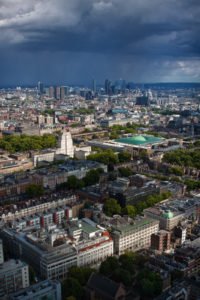
The photo below was taken directly after the photo above and focuses largely on the ground, rather than the sky. This photo contrasts greatly with the one above because it no longer evokes the same feelings, and instead focuses more on the colour and lines in the city. Your eyes are naturally drawn up the photo from the colour of the trees and houses at the bottom of the frame to the sharp and jagged nature of the buildings by the sky at the top. An equally interesting photo, but for different reasons, all because of the decisions made over the placement of the horizon. Importantly though, you’ll see that both images are stronger than the original image which cut the photo in half.Horizon 1 3 How to Choose Horizon Placement in Composition

If you want to include both the sky and the ground, but don’t want to cut the photo in half then I recommend changing the orientation to portrait. Again, you’re going to probably want to avoid placing the horizon in the middle of the frame, but the decision is up to you. I personally feel that the composition in the photo below is stronger than any of the photos above as it includes the most interesting parts of each photo. The weather had changed slightly between photos, meaning that there was less uninteresting sky in the photo, and that certainly helped towards finding the perfect balance between sky and ground. It’s all about thinking it through and experimenting with what works for you.Horizon 2 How to Choose Horizon Placement in Composition

High Horizon

Now that we’ve discovered why you may want to include a high or a low horizon, let’s have a look at some examples. The high horizon in this photo was an obvious choice as the sky was particularly plain and uninteresting during the evening in which I took this photo. Realising this, I made a special effort to find somewhere that I could include the foreground a little bit more to strengthen my photo. I found these strong and jagged rocks, which contrasted nicely with the sky, while blending in with the colour of the photo.Horizon 4 How to Choose Horizon Placement in Composition

Below is an extreme example of a high horizon and I chose to include it because it focused the interest onto the subject and foreground below. It made it look as if the visual weight of the subject forces the camera down, while at the same time, kept the photo stable by remaining straight across the top of the frame. There’s a lot going on in the lower half of this photo and the inclusion of the sky would have distracted from this.Horizon 6 1 How to Choose Horizon Placement in Composition

Low Horizon

Photos of clouds from below can be pretty boring and rely heavily on being ‘pretty’ for getting attention, but when you raise your angle, the clouds rely more on their shape and form to attract viewers. Because I had a higher vantage point and shape of the clouds were particularly interesting, I wanted to include as much of them as possible and this meant using a lower horizon. I included just enough of the ground to make the colour interesting and complimentary to the colour of the sky, while focusing most of the viewers attention towards the subject, which were the clouds.Horizon 1 How to Choose Horizon Placement in Composition

This is an example of a very low horizon this time, and I chose to take the photo this way, not because I wanted to emphasis the rather uninteresting sky, but because I wanted to focus on the dominance of the building. With the horizon that low, the feeling of balance is lost and that draws your attention towards the bold building which stands on top of it. By removing many other potential features from the frame, you focus the attention onto one specific point – the building.Horizon 11 How to Choose Horizon Placement in CompositionHow to Choose Horizon Placement in Composition How to Choose Horizon Placement in Composition