Tag Archives: low light photography

Urban Exploration Photography Tips – A Beginner’s Guide

Urban Exploration Photography (urbanex for short) is the art of finding old and abandoned buildings and locations, exploring them, and taking photos as you go.

It’s exciting, potentially dangerous, legally ambiguous, and a lot of fun.

Not only do you get to take photos of a really cool location, that very few people have taken photos of before, but you get to do it with your friends. You don’t have to be interested in photography to be interested in urban exploration. When I last went out on an Urban Exploration Photography trip, I took a friend who has no interest in photography (one of my trips would typically bore them), and they had a great time exploring an old boarding school.

This is some of the most fun I’ve had practicing photography.

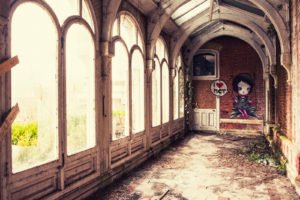
Lets get started. This is the school we visited.

Urban Exploration December 2012 55 Edit Urban Exploration Photography Tips   A Beginners Guide

Legality

The first thing I’d like to cover is the legality of Urban Exploration Photography, because as much fun as it is, it often involved trespassing. Whether anyone cares that you’re trespassing or not is another matter, but it’s trespassing all the same.

Some people even go so far as to break and enter. For me, this is a line which I’m not willing to cross. I’m not a vandal, I’m a photographer.

The two locations of photos you’re going to see in this post were captured without breaking anything, and without leaving a mark. We came, we took photos, we left.

There are a lot of vacant buildings around, but some will be guarded by security, so that they don’t end up in the same state of the buildings you’ll see in my photos. Urban Exploration Photography is very common to security, and some will be kind enough to allow you to take photos anyway, provided you stay within a certain area. You don’t get what you don’t ask for.

Urban Exploration December 2012 169 Edit 2 Urban Exploration Photography Tips   A Beginners Guide

Location Research

Finding a location is actually a lot easier than you may think. It’s getting the address and into the building that’s the tricky part.

The best place to look is in a forum.

A lot of forums will not divulge the location of the places they’ve explored because they don’t want just anyone accessing them, and to prevent attention from the police. If you’re a forum member and you send them a message, they will usually tell you. Failing that, a Google search often helps.

The photos in this post were taken about an hour’s drive away from where I live, and I’m sure if you think hard enough you can think of some abandoned building that you pass every day (hello recession) that you can access.

There are also countless forums dedicated to this form of photography. Some popular ones here in the UK are:

A quick Google search for ‘Urban Exploration [your area]‘ should produce plenty of results.

The two locations you’ll see captured in this post are an old girl’s private boarding school, and a lime works in the town of Cocking. Yes, really. Both of these were found by looking on a forum.

Urban Exploration December 2012 41 Edit Urban Exploration Photography Tips   A Beginners Guide

Safety

I can not stress how dangerous this can be. People have died in the past, because there’s a good reason why these buildings are closed off: they’re not safe.

  • Never go alone. Always have at least one other person with you. Trust me, this can be quite a scary hobby, because you never know who or what you may find, so bring a friend. Me and my friends even had a pact not to make each other jump.
  • Tell other people where you’re going. That way if you disappear through some floorboards, someone knows where to look for you.
  • Bring torches. The electricity is going to be shut off to many locations, and they’re often overgrown which make them even darker.
  • Wear tough boots. The amount of broken glass you’ll find is ridiculous. From people breaking in, to teenagers using it as somewhere to drink.
  • Wear layers. It’s better to catch your jacket or jumper on a rusty nail, than it is your bare skin.
  • Depending on the location, a hard hat’s not a bad idea either.
  • A face mask or respirator is a good idea if there’s a lot of dust or harmful chemicals.
  • A penknife is also really helpful because you may find you need to cut something, whether it’s your clothing, or some bushes in your way.

If you can’t find any friends who want to come with you, remember to check the forums and see if anyone wants to join you. It’s a good way to meet people with similar interests to you.

Urban Exploration December 2012 110 Edit1 Urban Exploration Photography Tips   A Beginners Guide

Photography Equipment

I personally can’t pack light. I’m going to San Francisco next week, and I’ll probably bring twice the amount of clothing and camera gear that I’ll actually use.

I brought a big bag of stuff, but I barely even changed my lens. Here are the essentials:

  • A wide angle lens. You’re shooting inside a lot of the time, and confined spaces mean you need a wider angle.
  • A flash isn’t a bad idea if you have the time to play around with it, and the option to take it off-camera.
  • A tripod is a must. These locations are often dark, and it pays to be able to take a long exposure to account for this.
  • Lens wipes, as you may come across a lot of dust or moisture.
  • Spare batteries, for the camera, flash and torches.
  • A backpack. A shoulder bag may be easier, but if you have to climb up or through something, you need a bag that’s not going to swing around.

That’s about it really. You should be able to fit all of this into a small backpack, which makes it much easier to access.

Urban Exploration December 2012 134g vintage12 Urban Exploration Photography Tips   A Beginners Guide

Techniques

Research the buildings fully before you try and access them. Find out what other people have said, and whether there’s security, squatters, etc. Have a walk around the building first to find the easiest and safest entrance, and ask in the forums how others got in.

Once you’ve accessed the building, you’re going to likely be shooting in low light.

This means either a long shutter speed, a wide aperture, or a high ISO, all depending on the equipment you have with you.

If you’ve got a tripod, then aim for an aperture of around f/11, and ISO about 400, and see how long your camera says you should be setting the shutter for.

And remember where to focus.

If you’re shooting handheld, then that means that you will need a wide aperture and a high ISO, so that no camera shake appears in your photo. Alternatively, you could use a flash, but I would only recommend this if you have a way to take your flash off-camera.

Urban Exploration December 2012 154 Edit Urban Exploration Photography Tips   A Beginners Guide

So long as you remain safe and aware of your surroundings, then you shouldn’t have a problem getting some great photos. If you run into security, it’s not the end of the world.

Just go out and have fun.

Urban Exploration Photography Tips A Beginners Guide Urban Exploration Photography Tips   A Beginners Guide

Top 20 Photography Tutorials

I’ve written over 100 posts on this website now, and as I look back on it, I realise that a lot of it would probably be lost to many users, who have only started using the website recently. This is Expert Photography’s top 20 photography tutorials; they’re the most popular tutorials on my website, as decided by the visitors who viewed them. Hopefully you can find something new and learn something today.

#1 - 4 Steps To Mastering Creative Night Photography

If you look at my personal portfolio, you’ll notice that I’ve got a good amount of night photography in there, and that’s because night-time is one of my favourite times to shoot. Shooting at night for me, came about from the fact that I didn’t really have too much free time in the day, so I would go out and practice my photography with some friends at night. It’s a slightly harder skill to master because the shots take longer to expose, I liken it to shooting on film; you think a lot more about your settings and composition before you shoot, which helps you to hone in your skill much quicker.night Top 20 Photography Tutorials

#2 - 4 Steps To Understanding ISO

ISO is one of three factors which determine the exposure of a photo, along with aperture and shutter speed. To really get the most out of your photos you need to know what all 3 do and how you can use them. Read this post to gain a more in depth knowledge of how to use your camera properly and start taking expert photos. ISO doesn’t just effect the exposure of the photo, there’s also grain/digital noise, and the more you understad about what it does, the better your photos will come out.iso Top 20 Photography Tutorials

#3 - Top 10 Photography Clichés You Should Avoid To Improve Your Photography

Photography is subjective, and people’s opinions on what’s cliché and what’s not is entirely up to them. Everything in moderation is the key to avoiding cliche photos, as you can get away with doing certain things a few times before it becomes boring and repetitive. If you’re new to photography, then avoiding the list of cliches below will help you to avoid taking photos that may well be dismissed as amateur.

A good photo will stand up to criticism, without the need for clichés or post processing.cliches Top 20 Photography Tutorials

#4 - 4 Steps To Understanding Focal Lengths

Knowing what the focal length means, especially in relation to your camera, is very important when it comes to buying lenses. This post will leave you well informed with the correct information at to what the lenses do, which ones are right for you, how to use them creatively, and all the technical speak you’ll need. It’s not just a case of how much a lens zooms, you’ve also go to be aware of the changes in perspective and the crop factor. This tutorial has had a steady stream of visitors since I posted it. focal length comparison Top 20 Photography Tutorials

#5 - 4 Steps To Understanding Shutter Speed and Its Creative Uses

Shutter speed is the most obvious of the 3 factors that create an exposure, and it has the biggest effect to your photos. With a poor knowledge of how the shutter speed will affect your photos, you’ll end up with blurred results. This post teaches you the right speed for the right situation, as well as how to use the shutter speed creatively. This was the first thing I learned when I started photography, so that’s probably why I play around so much with different speeds and night photography.Shutter speed 7 Top 20 Photography Tutorials

#6 - 10 Reasons Your Photos Suck

If you’re trying to improve your photography, then it helps to know where you’re going wrong. This article is all about pointing out where you’re going wrong and what you should be doing to fix it. It’s not easy taking consistently good photos, but once you’ve gotten the hang of it, it becomes incredibly rewarding. I wish someone had pointed out where I was going wrong back when I started, I’m positive that I would have improved at a much faster rate. photos suck Top 20 Photography Tutorials

#7 - How To: Shooting Into The Sun

Spring and summer is a great time to be outside, utilising the light that sun provides us, and shooting into the sun is a really creative way of capturing this. Shooting into the sun produces lens flare, but instead of it damaging your photos, you can learn to use it creatively to get spectacular results. It used to be something that I feared when taking photos, but now I embrace it, and adjust my exposure to produce some awesome results.shooting sun Top 20 Photography Tutorials

#8 - 10 Embarrassing Mistakes I Made As A Beginner Photographer

When I first bought my camera, I read the manual straight away; I used to take it on photo walks and read it before bed. This wasn’t really like me, but I knew I wanted to become good at photography and to do so, I was going to have to learn. I’d encourage everybody to do the same, but there’s only so much you can read in there; websites with lots of photos like this are much better. Here’s a list of stupid mistakes I made. How many have you made? How many are you still making?embarassing mistakes Top 20 Photography Tutorials

#9 - 4 Steps To Understanding White Balance

If you’ve ever taken photos indoors, without a flash, and wondered why everyone looks so orange, then this post will definitely help you. White balance can be hard to master at first, but once you understand it a little more, it can become quite intuitive, and understanding white balance is absolutely key to making your photos look good. Auto white balance just isn’t up to the job these days, and I’ve noticed this particularly with Canon cameras, so the faster you learn, the sooner you’ll start producing better results. wb Top 20 Photography Tutorials

#10 - How To: The Harris Shutter Effect

The Harris Shutter effect is a lot of fun to play around with when you’ve got some spare time and is an easy way to impress friends. This effect can be used in just about any situation where you can keep the camera steady and is a great way to show movement in a photo. It works by taking a sequence of photos and overlaying them in Photoshop or GIMP, and using different colour channels to overlap them.Harris Photos 2 Top 20 Photography Tutorials

#11 - 20 Photos And Tips For Shooting With Your Aperture Open

Shooting with the aperture wide open is a really good way of taking soft, naturally lit photos, as the aperture produces a shallow depth of field, and allow the maximum amount of light in. It’s also a great way of drawing the viewers eye to a certain part of the photo, as the majority of the photo will be out of focus. The photos in this post were shot on 3 different lenses; a 24-70 f/2.8, a 35mm f/1.4 and a 50mm f/1.8, and even though the maximum aperture varies, they were still shot at their maximum.open aperture Top 20 Photography Tutorials

#12 - 10 Top Tips To Taking Sharper Photos

Quality photos come from a good knowledge of how to take them properly. Taking sharper images are isn’t actually nearly as hard as you may think, the techniques are simple, and easily achieved by most people. I get asked all the time how I manage to take such sharp photos, and that’s the reason that I wrote this tutorial. This list will help you improve your images, to get the sort of detail you’ve been looking for, in 10 easy steps.sharper Top 20 Photography Tutorials

#13 - Understanding Metering Modes

Metering is the process that the camera goes through to look at a scene and work out what the exposure should be. There’s a variety of different modes that you can use to best suit the type of photo that you’re taking and in this post we’ll be looking at exactly what the modes do and when you should be using them. Simply switching from spot metering to evaluative metering can have a massive difference, like it’s had in the photo below. It ignores the sun from the sky, and meters for the majority of the scene.metering Top 20 Photography Tutorials

#14 - How To: Working With A Model

Working with models is a great way to experiment with photos that you couldn’t take on your own, and it often leads to even better photos as you have someone to bounce ideas off. This post covers everything you need to know about working with a model and how to act professionally around them to get the best results. Depending on where you find your models, will change how you should behave with them, but common sense applies to most, and it usually ends up being a lot of fun.working with a model Top 20 Photography Tutorials

#15 - 5 Steps To Understanding Aperture

Aperture is 1 of 3 factors that create an exposure, so understanding aperture is a good way of getting to grips with taking an evenly exposed photo. There are also negative and creative effects of different apertures and this post will teach you what they are and how to use them to your advantage. Aperture is probably one of the most difficult parts of exposure to get to grips with, but when you do, your understanding will yield much better results. aperture scale depth of field Top 20 Photography Tutorials

#16 - Understanding Exposure

Simply put: a photo is an exposure, and the more you understand about exposure, the better your photos will be. Once you start to grasp exactly what apertureshutter speed and ISO does to a photo, you’ll know how to use them correctly and creatively. This posts covers how to create the right exposure for a situation, as well as the negative consequences of each exposure factor. There are also links to read up in much more detail.exposure Top 20 Photography Tutorials

#17 - When You Should And Should NOT Use A Flash

I used to think of myself as someone who didn’t use the flash on the camera, but that was because I was completely unaware of the difference an off camera flash can make. I almost always carry one with me whenever I’m out now, even in the day time, as there’s a ton of different uses for it. We’re gonna start by looking at possible uses of the flash and then look at when you wouldn’t want to use it.should shouldnt flash Top 20 Photography Tutorials

#18 - The Ultimate Guide To Natural Light Photography

Natural light is type of lighting that we’re all very familiar with, but have you ever actually stopped for a moment to think about the effect that it has on your photography and how you can use it to your advantage? The difference between studio lighting or flashes and natural light is that we have very little control over it and its unpredictable nature, meaning that we have work around it, and with it.natural light Top 20 Photography Tutorials

#19 - How To: Fill Flash

We’ve all been there in a moment of frustration when we’re first starting out, wondering just why an expensive digital SLR camera won’t capture what our eyes are seeing, especially when a pocket camera does it with ease. That’s because SLR’s aren’t as intelligent as our eyes and they hand back the control that the pocket cam takes away. This post will help you to get one step closer to the perfect exposure.fill flash Top 20 Photography Tutorials

#20 - How To: Low Light Photography

The buttons you press on a camera to produce the right exposure in low light, are all the same as when you shoot in the middle of the day; the same rules of exposure apply, it’s just a little harder to get there. When there’s less light in a scene, you have 2 choices; either you create more light yourself or you change the settings on your camera to react differently to the light available. This tutorial is all about how to do that.low loght Top 20 Photography TutorialsThat’s all 20. If you have enjoyed them, then I would encourage you to click ‘Like’ below and become a part of my rapidly growing fan page. Thanks, Josh.

3 Steps to Taking Great Party Photos

Introduction to Party Photos

We’re reaching the end of October now and with Halloween just a few days away, party season is well and truly here. A post on party photography might seem like a weird idea, but it’s not as simple as you may think; that is, if you want to get good party photos. I’m known amongst my friends for my photography at parties, because I regularly have my camera with me, and record the parts of the night that are often forgotten by morning.

Step 1 – Setting up your Camera

Assuming that your party is either in the evening or indoors, you’re going to want to set your camera to manual mode to take control of the exposure. In low light conditions, you basically have two main options; you can either widen your aperture to capture the most light, or use a flash. These produce great results, but there’s plenty to be aware of before diving straight in.

Firstly, think about your personal style, do you prefer candid photography, or posed group photos? If you like candid photography, then wide aperture is a great choice, but you need to be aware that you’re still going to have people come up to you ask for a group photo, and with a wide aperture, comes a shallow depth of field, which won’t work out so well. If you’re more into group photos, then you need to have a deeper depth of field, and to make up for the lack of light, you’ll have to use a flash. It’s no secret that pop-up flash photography looks pretty terrible and is capable of ruining a photo, so use an off camera flash if you’ve got one, or try some of the techniques which we’ll get to in a bit.2011 01 08 at 00 34 09 3 Steps to Taking Great Party Photos

Make sure that your camera mode is in manual, and then start taking some test shots because it will help you to understand what you need to get a good exposure. It helps to know how your camera responds to particular lighting, because then it’s easier to set up your camera. I know that my camera doesn’t handle the ISO very well when it gets past ISO1000, so I set my ISO to there and work with my aperture and shutter speed after that. You’ll likely find that you shoot much wider angles at parties, which is good because it makes it easier to hold the camera steady at say, 1/50 of a second. So with my ISO at 1000 and my shutter speed at 1/50, I can easily play around with my aperture, depending on the light and the lens.

Aperture is the one thing that you’ll probably struggle with at a party, purely because of the depth of field, so if you’re happy to carry around an extra lens, say a f/2.8 or f/3.5 kit lens, then that can really help you out. If you can shoot without a flash while using a wide aperture, then that’s great because the lighting will look a lot more natural, but if not, then you’ll want to use a flash. The reason I say carry an extra kit lens, because if you’ve got a 50mm or a 35mm, then you’re gonna find that you want a wider angle than that when you’re shooting at a party, and if you’re using a flash and a narrower aperture anyway, it might as well be on a zoom lens.

Step 2 – Using The Flash

As I mentioned above, regardless of your style of photography, if you’re at a party at night or indoors, then you’re going to end up using a flash to help with the lighting. I strongly recommend the purchase of an external flash unit, but if you don’t have one, then we’ll get to your options in a bit. The great thing about an off external flash unit is that you can bounce the light off the ceiling to produce a more natural light, or you can use a diffuser to as a small light box to bounce the light indoors or outdoors. You can also buy transmitters for your flash too, so you can take the flash off the camera and have it coming from a different direction, although this is probably a little advanced for most parties.

Below is a photo which was taken indoors with the flash turned slightly behind me and pointing up to the ceiling, which you can see in the reflection in the mirror. This keeps a good amount of shadows still on the face and makes it look more like no flash was used at all. This sort of style is really good for casual parties, where you’re at a friend’s house and there’s no fancy lighting. The photo was taken at ISO 400, f/3.5 at 1/100 of a second, which allowed for more light because of the confined conditions and bounce flash.2011 01 08 at 00 09 11 3 Steps to Taking Great Party Photos

If you want to go the extra mile and use an off camera flash, then you can produce some better lit photos without making the lighting too garish. I used a Speedlight Transmitter for my photo below, and moved the flash around to the side. Because it was almost dark out, I had to push my ISO to 800, while narrowing the aperture to f/2.8. Because I was using a flash though, I knew the bust of light would freeze the motion, so I wouldn’t have to worry about movement in the photo. I did however want a bit around the moving bottle, so I chose a speed of 1/60. The more you use your camera, the easier it will be to make these decisions without having to think about them.Ben Katie McGowan BBQ 310711 8362 3 Steps to Taking Great Party Photos

If you don’t have an off camera flash unit, and you want to be able to use your flash, then I would recommend trying some slow sync flash. This involves using your flash, but setting your camera to manual so that you can allow for more ambient light and creative blur. This stops the camera for focusing so much on the bright direct light from the camera, and more on the ambient light in the background. The photo below is an example of slow sync flash, with direct light, although I did take it with an external unit as I had one on me. You can choose whether you want the flash to fire at the beginning or end of the exposure, depending on what you want the photo to look like. ISO500, f/3.5 for 1 second. 3 Steps to Taking Great Party Photos

I’ve shown you photos where you can easily bounce some light without having to push your camera too hard, but what about when it’s not so easy? You just need to remember that you have to work with whatever you’ve got, so if you’ve got limited gear, then use the techniques I’ve spoken about, but I would suggest a higher ISO so you can allow for more ambient light and can turn down the flash exposure compensation. It’s more about technique and composition than anything.IMG 8453 3 Steps to Taking Great Party Photos

Step 3 – Photos to Take

It’s all dependant on your personal style really, but if you’re being paid to take photos at a party, then there’s going to be a certain type of photo that is required of you. Think about what’s going on and who’s important at the party, and that should give you a good indication as to what sort of photos you should be taking. Here’s some of the photos that I like to take.

My personal style is fairly candid, so I like to shoot without a flash and capture moments that other people tend to miss. It gives a nice view over the party, as it captures the party for what it really is; a natural smile is ten times better than a posed one. 3 Steps to Taking Great Party Photos

The photo below was taken at a 30th birthday party, and it’s the birthday boy and his mum. I saw him walk past his mum and stopped him for the photo because this sort of photo is important to them, and they may have forgotten otherwise. You need to have a good amount of photos of the most important person at the party, without neglecting the rest of the guests.IMG 7713 3 Steps to Taking Great Party Photos

By all means enjoy the party, but be prepared with your camera so that you can take photos of anything interesting that’s happening. This is more of an action shot as you see the arm wrestle between the man and the girl, while just as importantly, you have all the heads surrounding them, looking on. This was shot at 24mm, which was as wide as the lens would go. I couldn’t have gotten this photo at a longer focal length with my primes lenses.2011 01 07 at 22 45 44 3 Steps to Taking Great Party Photos

Later on in the evening, when everyone has had a few drinks and loosened up a little bit, you’ll start to have people approach you for photos for group shots, and that’s a good thing. If they come up to you, then the photos are typically going to be a lot more fun to take and produce better results. This sort of shot is essential for any party really because it makes it look as fun as it was, and when it’s looked back on, they’ll remember it better.IMG 7862 3 Steps to Taking Great Party Photos

Finally, it’s always good to get personal shots of just a single person as they’ll have something to take away from it too. It doesn’t matter who you’re shooting, just make sure that they’re happy to have their photo taken and enjoying themselves.BT Tower London 8972 3 Steps to Taking Great Party Photos3 Steps to Taking Great Party Photos 3 Steps to Taking Great Party Photos

The 50mm f/1.8 Lens Review & Guide

Important Introduction

When it comes down to quality for price, bang for buck, a 50mm 1.8 is one of the best lenses on the market, and an upgrade that I recommend to every new SLR user. For a very small investment of $105 for the Canon EF 50mm f/1.8 The 50mm f/1.8 Lens Review & Guide or slightly more for Nikon, you can have one of the best upgrades that you can make to your camera.

The Right lens for your Camera

If you’re a Canon user, you have only one real choice, and that’s the Canon 50mm f/1.8 which I linked to above, but if you’re a Nikon user, it’s a little bit more complicated. You actually have 3 choices, depending on which camera you have. If you’re not using a Nikon D40, D40X, D60, D3000, D3100, D5000, and D5100, then your camera body will have an autofocus motor and you can buy the Nikon 50mm f/1.8D AF The 50mm f/1.8 Lens Review & Guide for $125.

If you have one of the cameras mentioned, then your camera body doesn’t have an autofocus motor built in, which means that you have to buy a lens that does – marked with an ‘AF-S’. Unfortunately for you, this is more expensive at $219 – Nikon 50mm f/1.8G AF-S The 50mm f/1.8 Lens Review & Guide. Now, regardless of whether you have an autofocus motor or not, you can both buy the 35mm f/1.8 for $199, which will provide a better viewing angle on a crop sensor, for which you’ll likely be shooting on – Nikon 35mm f/1.8G AF-S The 50mm f/1.8 Lens Review & Guide.4 200 800 The 50mm f/1.8 Lens Review & Guide

General Review

There are advantage of buying more expensive lenses, such as the Nikon ones listed above, as they have a better build quality. I used to regularly use my 50mm before I upgraded, and all that use does take its toll on the plastic build (glass inside) and toy-like features. The lenses are very light, small and are ideal if you’re looking to upgrade from your kit lens, but don’t want to carry around a load of extra weight. It’s true that you get what you pay for, but for a couple hundred bucks, you can produce some astounding results from these lenses. When you use a prime lens, which doesn’t zoom, the optics are usually much better quality as they’re not making as many compromises and the price comes down at the same time, so that’s why I endorse them so much.

Having used both the Canon and the Nikon, I can tell you that the focus does tend to suck on the lenses, as they’re slow and inconsistant. The small focus ring on each lens doesn’t do much to help with manual focus either, and the focus can tend to be quite loud, so watch out for that if you shoot video regularly. That being said, I’m looking back on these lenses now, after using much more expensive lenses, so my judgement has changed somewhat; you may not notice the difference so much if you’re using cheaper lenses to begin with.5 6 250 The 50mm f/1.8 Lens Review & Guide

Because of the crop factor on these lenses, the Canon feels more like a 80mm lens, the Nikon 50mm, is more like a 75mm lens, and the Nikon 35 looks like a 52.50mm lens. If you do choose a 50mm lens and you’re shooting on a crop sensor, then expect it to be quite far zoomed, although this isn’t necessarily a bad thing. They make ideal cheap portrait lenses in terms of focal length, but expect to have to walk backwards if someone asks for a group shot.

If you’ve been reading this blog for a while, then you should know all there is to know about how perspective changes at different focal lengths, but as I mentioned in my post on the crop factor, putting your full frame lens on a crop sensor body will not change the perspective – only crop it. This is a good thing because the way we see through our own eyes is generally considered to be similar to about 45mm, so by using a 50mm you’re quite accurately representing our natural view, and not compressing the perspective too much.

There are obvious downsides to cheaper lenses, but don’t be put off, because when you put a 50mm f/1.8 on your camera, you’re not going to want to take it off – I know I didn’t. It’s a tool for every photographers arsenal, and I personally don’t know anyone who has regretted the purchase. Enough of all this talk about why it’s so great, let me show you.1 8 320 400 The 50mm f/1.8 Lens Review & Guide

The Lens Guide

The very first thing you’ll notice about your new lens, is the ability to shoot in much lower light, without having to use the flash. This is because of the wider aperture, which allows more light in. If you don’t know your aperture scale, then I suggest you learn it, but for now, let me tell you that if your lens went as wide as f/3.5 before, it now lets in four times as much light, at f.1.8. When I say wide, I’m talking about the size of the hole in the lens that the light passes through. The photo below, was taken indoors in a dark room at f/1.8 for 1.200 of a second at ISO 100.1 8 200 The 50mm f/1.8 Lens Review & Guide

The next thing you’ll notice is that the depth of field (DoF), can go remarkably shallow, and that’s because of the way the light passes through the lens at a wider aperture. The wider the aperture, the shallower the depth of field. This can be used for great creative effect, and it works really well, but a common problem with a lot of people who get a 1.8, is that they think it looks so good, it’s all they ever use, so use it sparingly or it’ll lose its appeal. Notice from the photo below that the glasses on the face are in focus, but the end of the hat, and chin, are out of focus. This was also shot at f/1.8.1 8 60 500 The 50mm f/1.8 Lens Review & Guide

From the photo above, you may notice the circular shapes of colour in the background, and this is what’s referred to as Bokeh. Simply put, it’s the aesthetic quality of out-of-focus areas of a photograph. It relates to how nice the background blur looks when out-of-focus. When you’re shooting at wider apertures, the effect of the bokeh is accentuated, so it will look at lot more prominant than anything you would have seen with your kit lens. Because this is a cheap lens, made to a price, it’s not the highest quality (which you may see from the photo above), but when you use it properly, with distant light, you can produce some really nice effect. Again, the photo below was shot at f/1.8.1 8 250 The 50mm f/1.8 Lens Review & Guide

Selective focus with a f/1.8 is something that you may not have done too much of in the past. Because the depth of field can be made to look so shallow, it’s even more effective with this lens, and you can focus the viewers attention onto a certain part of the photo, while making them want to explore the rest at the same time. It’s a powerful technique, but like everything, remember not to overdo it.2 400 The 50mm f/1.8 Lens Review & Guide

When you’re shooting wide open, you’re going to produce some very soft photos, so if you want them to be sharper, you need to narrow your aperture a fair bit. I find around f/8 to be the sharpest point on my Canon 50mm f/1.8. The photo below was shot at f/7.1, and manages to keep the whole of the subject in focus, while making sure plenty of detail remained in the background, so that you could make out the burnt down pier. Experiment with wide apertures at first, but you may find that narrower ones suit your style a lot better.7 1 640 The 50mm f/1.8 Lens Review & Guide

As I mentioned earlier, the crop factor does make this lens appear more zoomed than you may want it to be, but that can’t really be helped, unless you opt for the 35mm – it’s really a matter of personal preference and budget. It’s all about working with the gear that you’ve got at your disposal. When I took the photo below, I had no tripod on me, and just my 50mm lens. Because I knew what effect this would have on my photos, I chose to find a position that would work for me, rather than to simple give up, as I would have typically shot this photo with a wider angle. I found a position on a dock further away, and shot this photo at f/4.5 for 8 seconds and I was very happy with how it came out.4 5 8s The 50mm f/1.8 Lens Review & Guide

I’ve spoken a lot about f/1.8, but the lens aperture will go as narrow as f/22, which is fairly common. This will give you a much deeper DoF so that you can have your background and foreground in focus. The photo below was shot at f/22 for 4 seconds, and as you can see, the deep foreground is in good focus, and you can still work out all the minor details in the background on the pier. It’s important to remember that the lens does have more uses than just low light photography or shallow depth of field.22 4s The 50mm f/1.8 Lens Review & Guide

Finally, as you start to collect more gear, you can use that to make your photos look even better. A 50mm lens is great, but when you use it in conjunction with an external flash unit (and off camera transmitter for the photo below), you’ll get even better results. Like I said before, it’s about working with what you’ve got, and when you’ve got a little bit more, it can become a lot easier (when you know what you’re doing) to get better shots.11 160 The 50mm f/1.8 Lens Review & GuideThe 50mm f1 8 Lens Review and Guide The 50mm f/1.8 Lens Review & Guide

How to Capture Awesome Nightclub Photography – 5 Easy Steps

Introduction to Club Photography

Nightclub photography is becoming increasingly popular, with a lot of young photographers using it as their way into finding their first paid photography work, while enjoying themselves at the same time. I often walk straight into clubs with no photo pass or anything, just a camera slung round my neck, and nobody ever asks any questions – it’s a great way to start getting more experience.BTL 13570 How to Capture Awesome Nightclub Photography   5 Easy Steps

Step 1 – Technique and Equipment

You’ll find that you’ll start to employ a lot of techniques from low light photography, night photography, light painting and slow sync flash, as you’re often left to make do in low light. As far as gear goes, if you want to actually come out with some good photos, you really need to have an external flash, but you can get away without one if you’re doing basic slow sync flash.

Here’s the kit that I use:

  • A camera body, preferably a newer one as they deal with high ISO a lot better.
  • Wide aperture lens, preferably f/2.8 and below, with the lens hood on (we’ll get to that).
  • A wide angle lens, so that you capture a lot is cramped conditions.
  • An off camera flash with a diffuser if you’ve got one.
  • A transmitter for you flash would be ideal if you want to up your game.

Step 2 – Setting Up Your Camera

When I walk into a club, the first thing I do is go to the places that I’m going to be spending the majority of my time shooting and find out what settings I’m going to use. Because the lighting is fairly controlled, I can set my camera to manual and set up different exposures for different situations and then save them to my custom dials.

A great way to ensure that you include enough ambient light is to set your camera to aperture priority with your ISO set and your aperture wide open and see what it tells you. I did this about half way though the night as it just confirmed my beliefs that it would be around 1/13. If you’ve got custom dials, I strongly suggest you look up how to set them on your camera as they can come in very handy (it’s easy to do), but if you don’t, then don’t worry, just keep your camera on manual. The two different places I might find myself shooting are in the crowd and at the DJ booth, so I adjust my camera for those.BTL 13820 How to Capture Awesome Nightclub Photography   5 Easy Steps

For the majority of my shots, my ISO is set to somewhere around 1000-1600, my aperture is almost always completely open (which will be f/2.8 for most of these photos), and my shutter speed ranges anywhere between 1/8 to 1/50 of a second. The ISO and aperture deal with all the ambient light whereas the shutter speed is used to freeze the motion, with the help of an off camera flash.

Step 3 – Different Photos To Take

There are five main shots that I like to take:

  1. DJ photos
  2. Crowd
  3. Venue
  4. People
  5. Staff

Starting with the obvious, you’re going to want to take photos of the DJ, especially if they’re a big name act and not just the house DJ. The way this differs to the rest of the club is that there is usually more lighting so that the DJ can see what they’re doing, which can often ruin the shot. For the photo below, I set my camera to f/2.8, ISO1000, at 1/25 of a second and pointed my flash upwards at quarter power without a diffuser cap, but the little white reflector sticking out. This shone enough light onto the subject while giving them the dark eyes I was looking for. The slow speed and wide aperture allowed some ambient light onto the DJ’s shirt which helped to make it more interesting.BTL 13781 How to Capture Awesome Nightclub Photography   5 Easy Steps

When you compare that you a higher budjet production of a dance music festival, you have a lot more light to play with and you’re not bothered by the small table lamps which are lighting up the equipment. I had so much more light to play with, my ISO was on 1250, aperture was set to f/2.8, but my shutter speed was set to 1/1000 as this DJ was prone to faster movement than this. I’ll move on to more creative photography for DJ’s in a bit.Outlook 2011 12850 How to Capture Awesome Nightclub Photography   5 Easy Steps

Crowd shots is something the promoter is going to be looking for as it helps them to promote their night, so you’ll want to make sure that you get as many of these as possible, particularly during the headline act. If you’ve got a flash then it’ll likely come in quite handy if you’re taking photos of small groups of people like in the club that these photos were shot. The light would be lost in larger clubs, but there would be a lot more lighting to help make up for that. Have a look at the photo taken below which used a flash, and then move on to the photo I took without to see the difference. This photo was shot at 1/13 of a second to allow the light and smoke from behind to creep through.BTL 13794 1 How to Capture Awesome Nightclub Photography   5 Easy Steps

When you’ve not got a flash, you can rely on the club’s lighting a lot of the time, but you will want to turn up your shutter speed as movement will be detected a lot easier without a flash. The photo was shot the same as the one above, only I turned up the shutter speed to 1/50 to freeze the motion. The photo below is one of the reasons I enjoy taking photos at live music events – the lighting allows you to get a lot more creative.BTL 13577 How to Capture Awesome Nightclub Photography   5 Easy Steps

Venue shots are important because they’re used to promote nights over Facebook so try to include a few of them. I’ll go into more detail about how to take these photos so that they’re a little bit more interesting, but for now we’ll focus on exposure. This photo used a flash, but it was diffused and bounced off a wall so it’s well hidden. Again, the photo was shot at f/2.8, ISO1000 at 1/40 of a second.BTL 13554 How to Capture Awesome Nightclub Photography   5 Easy Steps

Photos of people are fairly important as promoters often use this to promote their night again, by watermarking the images and tagging the photos so that people can see them. I don’t have an ultra-wide angle lens but these are typically used to capture as many people in the photo as possible while providing a cool fisheye effect. I personally think that this is a little bit over used and doesn’t look very original anymore. Again, ambient light is key here so keep the settings much the same, and if you don’t want the photos to look flat, point your camera upwards and use a diffuser on it to act as a light box.BTL 13547 How to Capture Awesome Nightclub Photography   5 Easy Steps

Lastly, if I know the staff want photos, or it’s a particularly special occasion, I’ll try to take photos of them too. This is good for when someone wants to become the face of the night and not a name, and you’ll often find this happens with much smaller nights. The settings you might use are much the same as the other photos, depending on the location, but you have much more freedom to play around as you can take them pretty much wherever you want.BTL 13526 How to Capture Awesome Nightclub Photography   5 Easy Steps

Step 4 – What to Watch Out for

This is a small list on how to look after your gear in a nightclub environment:

  • Drinks. They get spilt by drunk people all the time so watch out for anyone who’s had too much to drink, and keep the lens hood on your camera to protect from any splashes.
  • Thieves. Nightclubs are probably a bit worse for people stealing stuff so either keep everything on you where you can look after it, or keep it somewhere that you know is safe, like in the DJ booth or with the promoter.
  • Loud music. Pick up some earplugs at the beginning of the night as you’ll likely be subjected to a lot of bad/loud music which will damage your hearing before long.

Step 5 – Ideas For Different Styles

Context is important in anything you take a photo of, and this can be done pretty simply by following the rule of thirds and including some background detail to a photo. Again, I know I’ve been banging on about this, but if you want it to work, you’ve got to include some ambient light. Contrast that with a flash like I’ve done below and you’re onto a pretty good thing.BTL 13562 How to Capture Awesome Nightclub Photography   5 Easy Steps

Slow sync flash allows you to capture the movement of a subject without producing a blur which takes away all the detail. I’ve written a whole blog post on it which can be found here, but it’s pretty simple to get your head around. Play around with the shutter speed to match the speed of movement of your subject and you’ll soon come up with some cool photos. Again, this works better in more exciting lighting as it produces a more interesting effect, but if the lighting is particularly dull, try and use the lights from the DJ mixer to produce some light trails.BTL 13736 How to Capture Awesome Nightclub Photography   5 Easy Steps

Black and white photos are really good at producing a certain mood and they’re very useful if the lighting isn’t very good. The style of music which was being playing the the photo below was very bass heavy and minimal, so using black and white worked really well.BTL 13564 How to Capture Awesome Nightclub Photography   5 Easy StepsHow to Capture Awesome Nightclub Photography 5 Easy Steps1 How to Capture Awesome Nightclub Photography   5 Easy Steps

How to Capture Great Photos in Low Light

What We're Covering Together

The buttons you press on a camera to produce the right exposure in low light, are all the same as when you shoot in the middle of the day; the same rules of exposure apply, it's just a little harder to get there. When there's less light in a scene, you have 2 choices; either you create more light yourself or you change the settings on your camera to react differently to the light available. This tutorial is all about how to do that.

Exposure

If you've not read the tutorials inside my Understanding Exposure blog post, then I strongly suggest you go back and read them now – there's a lot more to it then you may think. Putting that aside though, you basically have 3 ways of getting more light into your camera in a low light situation; aperture, shutter speed and ISO.min How to Capture Great Photos in Low Light

Aperture

This is the hole the light passes through in your lens and the wider it is, the more light it lets in. Rather confusingly, the wider the aperture, the lower the f-number, so bear that in mind. This step isn't particularly useful if you're still using your standard kit lens as you'll find that your maximun aperture is somewhere around f/3.5, which won't let in enough light to really help out. What I suggest is to buy a cheap, but effective prime lens with a maximum aperture of about f/1.8 (Canon EF 50mm f/1.8 ii) – this is commonly referred to as a 'fast' lens as it allows you to take photos at faster shutter speeds. The photo below was shot on film but if i remember rightly, it was f/1.7 for 1/30 of a second at ISO 200.CNV00017 How to Capture Great Photos in Low Light

The point here is that if you want to take a well exposed photo in low light, you need to have a lens with a wide aperture as it lets more light in. Setting your lens to stop at f/1.8 actually lets in 4 times more light then f/3.5, which is a huge difference for a small change in number. A wide aperture will produce a shallow depth of field though, and there's no way around that, unless you make your aperture narrower again and increase the ISO or slow down your shutter speed.

If you're taking photos of groups of people in the pub or somewhere, be careful about how wide your aperture is because you'll end up with half the people not in focus. This is a good time to use the flash, but take my advice and invest in a proper external flash unit, it'll make a world of difference.14 30 1600 How to Capture Great Photos in Low Light

Shutter Speed

Shutter speed is step 2 in creating an exposure and also affects how much light enters the camera – the faster the shutter speed, the less light that will enter the camera. If you're out and about in a low light situation, chances are you're not going to have a tripod with you, so you'll have to be careful not to select a speed too slow or you'll end up with blurry photo.

As a rule of thumb, the average person can take a sharp, blur-free image by setting the speed to a fraction of a focal length. For example, to take a photo at 30mm, you would set the shutter speed to 1/30 of a second; any slower and motion blur is likely to occur. It’s worth noting however, that this rule is only relevant to full frame cameras. For a crop sensor, due its magnifying effect, you would be better off choosing a speed of 1/45 of a second and you'll need to drastically increase your shutter speed if the subject is moving.

If you happen to have a tripod with you and you're shooting a still object, then you have the ability to make the shutter speed virtually as long as you want. What I recommend is shining a torch on your subject so that you can focus properly and using an external shutter release trigger to minimalise camera shake.56 30 400 How to Capture Great Photos in Low Light

Another technique worth trying is using a relatively long shutter speed in a crowd of people and capturing their motion blur while the objects around them remain still, like in the photo below.56 30 400 1 How to Capture Great Photos in Low Light

ISO

This is slightly more tricky to manage on most cameras as the higher the ISO, the more digital noise there will be, and this can be pretty ugly. If you're struggling to get the exposure you're looking for with just changing the shutter speed and aperture, then the best thing to do is to raise the ISO. Remember how stops work though, if you double the ISO number, you're doubling the amount of light that your camera is seeing.

I find that high ISO's on my camera aren't very good at determining colour so you might want to consider changing your photos to black and white. That gives the photos a nice warm and old feeling to them and the high ISO actually adds to this. Typically though, I don't raise my ISO to anything further then about 1600 – if i need more light after that, I use a flash unless i'm doing it for artistic effect like the photo below shot at f/2.8, for 1/8 of a second at ISO3200.28 8 3200 How to Capture Great Photos in Low Light

Low Light Photography with a Flash

When you're shooting groups of people in low light, it's best to use a flash. As I explained above, if you don't have your aperture too wide, you're going to end up with a shallow depth of field and not everyone in focus.

If you only have a pop-up flash on your camera, then you're limited with what you can do with it really, but some of these techniques will still apply. Firstly, just because you're using a flash, it doesn't mean that you can set your ISO all the way back down to 100, because if you do, you'll start to lose background detail in the dark. I like to make leave my ISO on about 400 as I feel it's an acceptable amount of grain and detail – all cameras are different though so play around with yours to see what you're comfortable with.

If you're using an external flash then it's best to bounce the light off of a wall or ceiling or to use a diffuser to make the light look a lot less harsh. A lot of the time when a flash is used properly, someone who's not really into photography can't even tell that a flash has been used, which is exactly the reaction you want. Image below was taken at f/5.6, 1/50 of a second at ISO 500 with the flash bouncing off the ceiling. 56 50 500 How to Capture Great Photos in Low Light

Playing with light trails can produce some really cool results, and all you have to capture this is to take a photo of someone with a flash pointed directly at them, and have the shutter speed long enough to capture the blur that comes afterwards. Have a look at my example below taken at f/11, for 5 seconds, at ISO 100.11 5 100 How to Capture Great Photos in Low Light

Tips

Here's some tips to bear in mind when you're using your camera in low light conditions:

  • If you're in a dark room and you want your photo to accurately capture the environment you're in, the photo should be a little bit underexposed.
  • Getting the photo take priority over worrying about ISO noise.
  • Keeping your elbows together and not leaning forward will help you to hold the camera steady for longer, allowing you to lower your shutter speed.
  • Turning up your camera's exposure compensation will help your camera to overexpose, and in darkened conditions, produce more accurate results.

wicks How to Capture Great Photos in Low Light

If you have any questions or tips of your own, please feel free to leave a comment and we’ll get back to you.How to Capture Great Photos in Low Light How to Capture Great Photos in Low Light