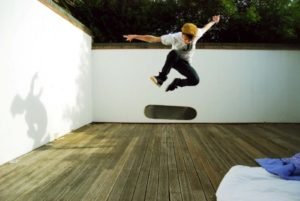
Composition is a funny old thing, because it’s common knowledge that learning composition will help your photography, but it’s also something you should never really pay too much consideration too. I always feel that it’s best to teach people composition under the guidance that it’s training a person’s eyes to look at a potential photo in a different way. You should never just blindly follow the ‘rules’, but you can use your new knowledge to shape your photos into something which is much more pleasing to the eye.
This is probably the first compositional rule that any photographer comes across, and that’s for a very good reason – it’s simple and it works. The basic premise is that you divide your camera’s frame up into thirds and plant key objects in these lines, and the composition will work better. This often works really well and if you’ve not learnt much about photography yet – it’s a great way of dramatically improving your photos and make them more interesting. The idea is that the viewer gets to see more than just the subject and is free to, and encouraged, to explore the photo themselves. There are more basic elements of composition to study, but this is great for trying out and getting to grips with compostion.
Here is the full tutorial on the Rule of Thirds.
Visual weight is different to size or weight as we know it, and it’s largely down to different elements, such as human eyes and writing. When you can understand visual weight a lot more, you’ll start to understand how people look at photos, and how you can position certain elements in a frame to direct the viewers attention. It’s not so much a tool, or a rule, as it is an understanding.
Here is the full tutorial on Visual Weight.
Balance in a photo has a big affect on how we feel when we look at the photo, as an unbalanced photo can make us feel uneasy, where as a balanced photo, will make us feel more relaxed. It really doesn’t matter whether you choose to make the photo balanced or unbalanced, but you should understand why you’ve chosen one or the other, and have reasons to justify this choice. Again, it’s one of those situations where the more you know, the easier it will be to produce the desired effect.
Here is the full tutorial on Balance.
If you take photos of people, then you take photos with eye lines, so it’s important to understand the affect that they have over how we view photos. Seeing as you’re definitely following every tutorial I’ve provided in this guide, you will have a good understanding of visual weight already, so you should understand the power that having a face (and eyes) in a photo has on it. But there’s much more to it than that. Eye-lines have the ability to focus our attention on another part of the photo, as well as producing tension and other photographic elements. Although they’re not physical lines, they can be used as such to produce different elements, such as triangles and vertical lines.
Here is the full tutorial on Looking & Interest.

Speaking of triangles, lets have a look at them next. Triangles are in almost everything we see, in one way or another, it’s just a case of distinguishing them and knowing what to do with them. They make great compositional tools as they’re easy to make, manipulate, and are remarkably common. Triangles are a great way of combining different compositional techniques such as lines and paths and using them to create a more interesting part of a photograph, but the best part about using a triangle is their ability to make a photo feel stable or unstable.
The majority of your photos will have three distinguishable points of interest, so it’s just a case of identifying these, and linking them together in a way that makes sense.
Click here for the full tutorial.

Before we get ahead of ourselves, we should really look at what a single point does to a photo, because there’s actually much more to it than meets the eye. When you’re working with a single point of interest in a photo, it’s one of the most basic forms of composition available, so quite a common occurrence and it pays to know what to do with it. A single point can provide interest to an otherwise plain photo, and they’re usually fairly small and contrasting to the rest of the photo. A photo doesn’t need to have any points of interest to be successful though, just have a look at the most expensive photo in the world as an example.
Here’s the full article.
When a frame is being divided by a single, dominant line, it’s more often than not, a horizon, as they’re fairly common in outdoor photography, particularly landscapes. If the photo is of nothing particularly interesting, then usually this line becomes the dominant part of the photo for the way in which it separates the frame. Exactly where you place the horizon in a frame can have a huge affect on the image; it’s all about which part of the photo is the most interesting, and how you want to make your viewer feel with the divide.
Frames are a great way of using a photographic element to lead the viewers eyes into the frame to focus them on a particular point, and the sense of repetition that they can provide, produce depth and a path for the eyes to explore. A photo of a scene with a foreground feature makes for much more interesting build up to the main part of a photo and can, in some cases, carry equal weight to the rest of the photo.
Click here to read the full tutorial.
Dynamic tension is a way of using the energy and movement available in various features of the frame, to draw the eyes out of the picture in contrasting directions. We’ve already looked at a variety of different lines that you can use in a photo to make it more interesting, but dynamic tension takes these lines and adds varying degrees of contrast between them, making them much more interesting. The simplest and most obvious photo that I have that demonstrates dynamic tension is the one below – the lines move out from the center of the photo to edge of the photo.
This is where composition can start to get a little bit more advanced, but tends to lead to more interesting photography, as you take the knowledge that you’ve already learned, and use it to create photos with more depth.

Speaking of depth, here’s some useful tutorials to produce depth in your photos. It’s another page like this, with links to the relevant articles, but if you’ve got the time, and you want to learn more, then it’s really worth checking out.
When we take a photo with our cameras, we turn a 3D image into just 2D, and that can cause problems when you’re trying to display depth. It has its advantages and disadvantages, depending on what you’re trying to convey with your photo, but ultimately it holds you back when you’re trying to add depth to a photo.
Click here to check out the full article.